RFID vs. Barcode: How to Choose the Optimal Solution for Modern Warehousing/Inventory/Asset Management?
Dec 05, 2025
In the pursuit of efficiency and accuracy within modern logistics and supply chain management, the digital transformation of warehousing, inventory, and asset management is a fundamental requirement for businesses aiming to reduce operational costs and increase overall throughput. As organizations attempt to upgrade their facility operations for the 2026 fiscal year and beyond, the debate surrounding automatic identification technologies frequently centers on two dominant methodologies: Radio Frequency Identification (RFID) and standard Barcode systems. Faced with the immediate need to optimize supply chain visibility, how do procurement managers and operations directors choose the correct path? Should a facility stick with the classic, proven optical scanning methods, or transition to radio frequency innovations? This comprehensive technical analysis will evaluate both technologies from multiple operational perspectives, assisting you in finding the optimal solution based on precise industrial scenarios.
How They Work: Optical Scanning Versus Radio Frequency Sensing
To make an informed infrastructure decision, it is essential to understand the underlying physics of how each technology captures data. The traditional barcode encodes data linearly or in a two-dimensional matrix using the width and spacing of black and white elements. The data extraction process requires an optical device, such as a rugged Industrial Handheld Barcode Scanner, to project a light source directly onto the label. This optical process fundamentally requires a clear, unobstructed line-of-sight between the scanner's sensor and the printed code. It is an active, one-to-one communication protocol that relies heavily on operator positioning.
Conversely, RFID operates on the principles of electromagnetism. A standard passive UHF RFID system consists of a microchip attached to an antenna (the tag) and a separate transceiver (the reader). When the tag enters the electromagnetic field generated by the reader, it utilizes the harvested energy to transmit its unique identifier (EPC) back to the receiver. The primary mechanical advantage here is the complete elimination of line-of-sight requirements. Furthermore, RFID protocols utilize anti-collision algorithms, allowing a single reader unit to capture hundreds of distinct tag signals simultaneously within milliseconds, even when the items are obscured inside cardboard boxes, plastic totes, or wooden crates.
Core Capability Comparison: Evaluating Efficiency, Data Payload, and Total Cost
When evaluating capital expenditure (CAPEX) versus operational expenditure (OPEX) savings, the technical specifications of both systems must be compared objectively. Barcodes boast an unparalleled cost-to-production ratio. A standard thermal-transferred barcode label costs fractions of a cent to produce and can be integrated into existing packaging lines with minimal disruption. However, the data payload is strictly limited to a string of characters (typically up to 100 characters for a 2D matrix), and the label is highly susceptible to environmental degradation such as moisture, grease, or physical abrasion.
RFID tags require a higher initial investment per unit, typically ranging from a few cents for standard paper inlays to several dollars for specialized on-metal or temperature-resistant variants. However, they offer a significantly larger data payload (up to 8KB), which can be dynamically rewritten or locked during the manufacturing process. From a durability standpoint, RFID tags can be embedded inside plastic casings or directly integrated into product housings, rendering them immune to surface-level contamination.
Technical Parameter
Barcode Technology
RFID Technology
Data Capture Method
Optical line-of-sight, single item capture
Radio frequency, bulk item capture
Throughput Speed
Low (Dependency on manual operator speed)
Extremely High (Up to 1,000 tags per second)
Read Range
Centimeters to a few meters
Up to 15 meters (UHF Passive)
Environmental Resilience
Low (Fails if scratched or covered)
High (Operates through dirt, paint, and plastics)
Scenario-Based Selection: Defining the Precise Industrial Application
Determining the correct technology relies entirely on the specific transactional process being measured. A barcode infrastructure is highly recommended for operations managing fast-moving consumer goods (FMCG), retail front-end checkout systems, or simple warehouse receiving processes where labor costs remain sustainable relative to throughput demands. If an organization is currently migrating from manual paper logs to their first digital Warehouse Management System (WMS), standard optical barcodes provide the lowest barrier to entry and immediate operational stabilization.
Conversely, RFID justifies its higher CAPEX in scenarios requiring absolute asset traceability and extreme throughput velocity. For example, consider the management of high-value industrial components, such as specific Distributed Control System (DCS) core modules like the IS220UCSAH1A. Tracking the exact lifecycle, calibration dates, and precise warehouse location of such critical hardware requires the data persistence and automated tracking capabilities of RFID. Furthermore, deploying a Long Range RFID Reader at high-traffic dock doors enables automated inbound and outbound manifest verification. Forklifts can drive through portal antennas without stopping, automatically verifying dozens of mixed-SKU pallets against the ERP shipping notice, fundamentally eliminating manual dock-door bottlenecks.
Another critical application for RFID lies in asset security and compliance. In high-value manufacturing or IT server rooms, installing a dedicated Warehouse RFID Access Control System ensures that authorized personnel and corresponding tagged assets are logged instantaneously. If an unassigned high-value component crosses a facility threshold, the system immediately registers an exception protocol, providing an objective layer of loss prevention that optical codes cannot replicate.
The Hybrid Implementation: Integrating for Optimal ROI
It is a common misconception that an organization must choose exclusively between the two formats. The most objectively successful deployments in large-scale logistics often utilize a hybridized, tier-based architecture. A strategic approach involves applying RFID tags at the macro-logistics level—such as reusable transit items (RTIs), standard shipping pallets, or master cartons—to facilitate high-speed automated routing through the global supply chain. Simultaneously, individual item-level packaging maintains standard printed barcodes.
This 1+1 > 2 strategy ensures that bulk distribution centers achieve maximum throughput using radio frequency automation, while end-user retail stores or localized assembly stations can still utilize inexpensive optical scanners for final disposition. This methodology prevents over-engineering the system while strictly controlling consumable tag costs.
Final Executive Summary and Implementation Outlook
In conclusion, the decision between barcode and RFID technologies is an objective exercise in matching data capture capabilities with operational bottlenecks. Barcodes provide a low-risk, highly standardized mechanism for basic inventory identification. RFID technology shifts the paradigm by automating the data collection process, converting static inventory into dynamic, trackable data points across the entire facility footprint.
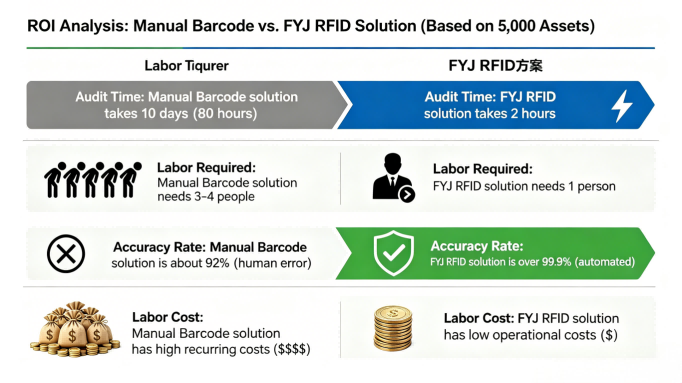
For organizations evaluating an upgrade, we recommend initiating a compartmentalized pilot program. Select a specific, high-friction workflow—such as the outbound verification of high-value industrial components—and run an RFID trial parallel to the existing barcode process. Analyze the resulting metrics on error reduction, labor hour reclamation, and inventory accuracy to calculate a definitive Return on Investment. By relying on objective performance data rather than technological trends, your organization can confidently engineer a highly efficient, future-proof logistics architecture.
Read More



 en
en 


 IPv6 network supported