
In the high-stakes world of Third-Party Logistics (3PL), lead time is not just a metric—it is your lifeblood. In an industry where same-day shipping is the norm and next-day delivery is expected, 3PL providers live and die by their fulfillment speed.
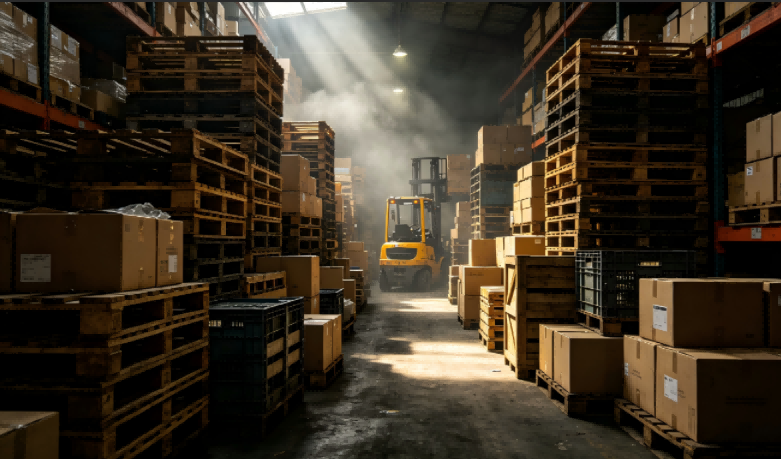
However, when peak seasons hit, or global supply chains bottleneck, warehouses inevitably face severe capacity crunch and congestion.
When a facility’s utilization crosses the 90% threshold, dedicated rack spaces run out. Aisles, staging zones, and temporary yards become packed with double- or triple-stacked pallets. To maintain basic traffic flow, forklift operators are forced to constantly shuffle and relocate temporary pallets.
This is where the ultimate 3PL nightmare begins: the "Ghost Pallet" phenomenon.
A pallet originally logged in Staging Area A is moved three times to clear a path and ends up tucked in the deep corner of Zone C. The Warehouse Management System (WMS) location data becomes instantly obsolete. Your pickers are left wandering through a multi-thousand-square-foot "pallet maze," blindly searching for a single shipment.
When order cycle times stall, SLA (Service Level Agreement) penalties kick in, shippers get furious, and your hard-earned reputation vanishes.
To survive the congestion storm, 3PLs must move beyond manual search. The integration of Intelligent Sound & Light (LED) Tags with FYJ Warehouse Management Software (WMS) is the ultimate solution to stop losing pallets and protect your warehouse throughput.
When a warehouse is congested, traditional inventory tracking methods break down:
If moving pallets is unavoidable, the only logical solution is to make the pallets announce their own location.
These are rugged, battery-powered active IoT devices (utilizing BLE, Active RFID, or UWB) mounted on the side of pallets or shipping containers. They feature ultra-bright, multi-color LED lights and high-decibel buzzers capable of cutting through loud warehouse environments.
A smart tag is only as good as the software directing it. FYJ WMS acts as the central command. By integrating seamlessly with your warehouse’s wireless network and the active tags, FYJ WMS dynamically bridges the gap between digital inventory records and physical locations.
When a picker receives a retrieval task on their PDA, FYJ WMS doesn't just show a generic zone. It instantly triggers the specific tag on the target pallet, turning a frustrating treasure hunt into a 10-second pickup.
Implementing FYJ WMS + Sound & Light Tags completely redefines how your team handles temporary and misplaced pallets:
[Retrieval Order in FYJ WMS]
│
[Signal Broadcasted via BLE/WiFi Gateways]
│
[Target Pallet Tag Activates: Ultra-Bright LED Flashes & Buzzer Beeps]
│
[Operator "Follows the Light" & Locates Pallet in Seconds]
│
[PDA Scan Confirms Pickup ── Tag Returns to Low-Power Standby]
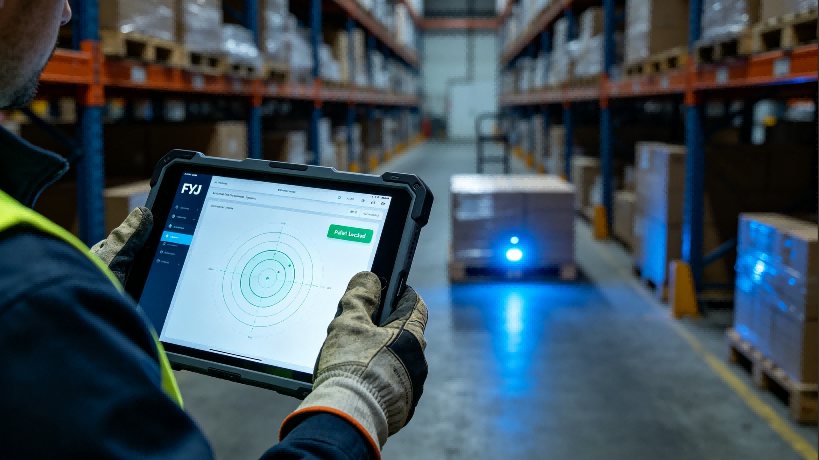
By transforming "searching" into "spotting," your pallet retrieval time drops from minutes (or hours) to under 10 seconds. This keeps your dock doors moving and ensures zero shipping delays.
In 3PL, keeping shippers happy means hitting strict turnaround times. The FYJ solution guarantees 99.9% inventory visibility and drastically reduces order cycle times, turning your operational resilience into a powerful selling point to attract high-volume brands.
During peak seasons, 3PLs rely heavily on temp labor. Training them to navigate a highly congested warehouse is difficult and error-prone. With sound and light guidance, a temp worker can find pallets as fast as a 10-year veteran.
Whether you are storing pallets in low-light mezzanine zones, dense drive-in racks, or temporary outdoor yards, the piercing buzzer and high-intensity LED light ensure that nothing remains hidden.
Warehouse congestion is an operational reality, but losing track of your inventory doesn't have to be. By combining FYJ Warehouse Management Software with smart sound-and-light hardware, you eliminate the friction of pallet relocation. You protect your pickers' sanity, eliminate wasted labor hours, and most importantly, defend the speed and accuracy your clients pay for.
Protect your warehouse throughput. Don't let misplaced pallets stall your operations.
To help you benchmark your warehouse performance and learn more about industry standards for asset tracking, review these whitepapers and studies from leading supply chain authorities:
Ready to see how FYJ WMS can integrate with your smart tags? [Schedule a Live Demo with an FYJ Solution Expert Today].
Q1: How long does the battery last on these sound-light tags?
A: The tags leverage Ultra-Low-Power BLE 5.0 mesh technology. They remain in a deep sleep state, consuming almost zero energy until triggered by FYJ WMS. Under typical peak-season usage, a standard battery lasts between 2 to 5 years. Low-battery warnings are automatically pushed to the FYJ WMS dashboard so your team can proactively swap them.
Q2: With thousands of pallets in the warehouse, won't multiple flashing tags cause confusion?
A: No. FYJ WMS supports multi-color grouping and localized routing. You can assign different LED colors to different pickers (e.g., Picker A sees a flashing Green light, while Picker B sees Blue). Additionally, the system only activates the tag when a picker is within proximity or actively processing that specific order, preventing visual clutter.
Q3: Can we integrate these tags if we already have an existing ERP or legacy WMS?
A: Yes, easily. FYJ WMS features robust, open API architectures. We can deploy our system as a dedicated "Location Middleware" that sits between your existing ERP (such as SAP, NetSuite, or Microsoft Dynamics) and the hardware tags, requiring zero overhauls to your core business processes.
Q4: Are the tags durable enough to withstand forklift impacts?
A: Absolutely. These tags are built for industrial logistics environments. They feature heavy-duty, impact-resistant ABS+PC housings, come with IP67 dust and waterproof ratings, and are typically mounted inside recessed protective brackets on the pallet to shield them from physical collisions.

----------------------
Hi! Click one of our members below to chat on
 en
en 


 IPv6 network supported