AI RFID Gates Are Changing Retail Loss Prevention: How FYJ Omni-Eye Improves Entry and Exit Recognition
Sep 11, 2026
RFID security gates have been used in retail for years.
The traditional logic is simple: when a tag is detected near the exit, the system decides whether an alarm should be triggered.
That approach works in simple environments. But modern retail stores are becoming more difficult.
Products are displayed closer to entrances. Customers may stop near the door, try on shoes or clothing, walk back and forth, or carry several items together. At the same time, retailers want to use every part of the store efficiently instead of leaving a large empty area around the RFID gate.
This creates a problem:
How can an RFID gate tell the difference between a tag that is simply nearby and an item that is actually leaving the store?
The FYJ AI Omni-Eye RFID Gate approaches this problem differently.
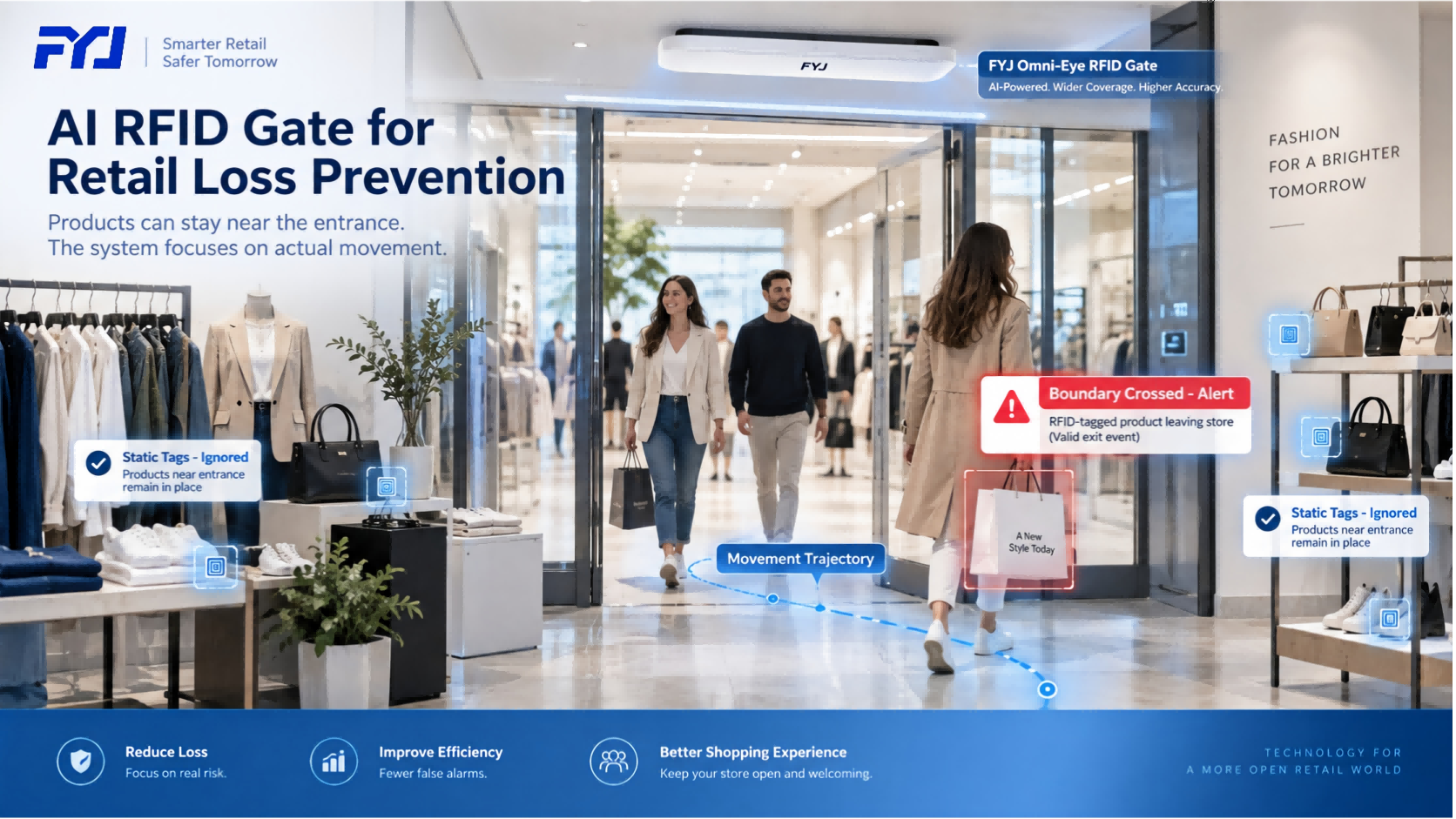
Instead of treating every detected RFID signal as an event, the system analyzes the movement of RFID tags through space and uses AI-based trajectory recognition to determine whether an item has actually crossed the monitored boundary.
That changes how RFID access control can be used in retail.
Why Traditional RFID Gates Can Be Difficult in Retail Stores
A retail entrance is rarely a controlled environment.
Customers stop, turn around, browse nearby shelves and move unpredictably.
Products may also be placed very close to the entrance.
For a conventional RFID gate, this can create several challenges:
- Tags near the entrance may be read even when products are not leaving
- Static merchandise may interfere with moving tags
- Multiple products may pass through the gate together
- Fast movement can make identification more difficult
- Store layouts may require repeated parameter adjustment
- False alarms can interrupt both customers and employees
When false alarms happen too often, staff gradually stop trusting the system.
That is why RFID gate performance should not be evaluated only by reading distance.
The more important question is:
Can the system understand whether the tagged item actually crossed the boundary?
1. The Entrance Area Can Become Usable Retail Space Again
One practical problem we often see in RFID retail projects is the area around the entrance.
With conventional RFID gates, retailers may deliberately keep products away from the gate because nearby tags can create interference or unwanted reads.
That means valuable display space is lost.
The FYJ Omni-Eye RFID Gate uses phase trajectory analysis and movement recognition to distinguish between products that remain inside the store and products that actually move through the exit.
This means merchandise such as:
- Clothing
- Shoes
- Bags
- Accessories
- Other RFID-tagged products
can be positioned closer to the entrance without relying only on distance from the reader to prevent unwanted alarms.
A customer may stand nearby, stop, turn around or move around the entrance area.
The important factor is not simply whether the tag can be read.
It is how the tag moves.
This gives retailers more flexibility when planning store displays and customer flow.
2. From “Tag Detected” to “Movement Understood”
Traditional RFID access control often relies heavily on whether a tag has entered a readable zone.
The Omni-Eye system looks at more information.
For each RFID tag, the system can analyze changes in its phase trajectory and movement process to determine its direction and relationship to the monitored boundary.
Instead of making a decision from a single signal event, the system evaluates a continuous movement process.
Think of the difference this way:
Traditional logic
Tag detected → Process tag → Decide whether to alarm
Trajectory-based logic
Tag detected → Track movement → Analyze direction → Determine whether boundary was crossed → Decide whether to alarm
That extra layer of movement analysis is what makes the system better suited to complex retail entrances.
3. Cross-Reading Becomes Easier to Control
Cross-reading is one of the most common problems in RFID projects.
A reader may detect tags that are physically close to the entrance but are not part of the actual entry or exit event.
Examples include:
- Clothing displayed beside the entrance
- Products placed on a nearby shelf
- Items carried by customers who remain inside the store
- Static RFID tags within the reader's surrounding range
If every readable tag is treated as an exit event, unnecessary alarms become difficult to avoid.
The FYJ Omni-Eye RFID Gate does not rely only on whether a tag is visible to the reader.
It also considers whether the tag is moving and how that movement changes over time.
Static or unrelated tags can therefore be treated differently from tags actually moving through the monitored passage.
For retailers, this means fewer situations where store layout has to be redesigned simply to accommodate the RFID gate.
4. Multiple Items Moving Together Are a Real Retail Scenario
A customer rarely carries products one by one.
They may leave with:
- Several garments stacked together
- Shoes inside a shopping bag
- Multiple accessories
- Products partially blocked by other items
These situations are much harder than reading a single RFID tag in an open environment.
The Omni-Eye RFID Gate continuously analyzes the movement process of multiple tags as they pass through the monitored area.
This makes it suitable for dynamic multi-tag environments, where several RFID-tagged products may enter or exit at the same time.
The goal is not simply to maximize raw tag reads.
It is to connect those reads with actual movement.
That distinction becomes especially important in busy stores.
5. Fast Movement Should Not Mean Unclear Movement
Another challenge appears when customers walk quickly through an entrance.
The system has less time to collect information.
A simple threshold-based system may have difficulty deciding whether the tag:
- was only briefly detected,
- was near the entrance,
- or actually crossed the exit.
Trajectory recognition gives the system more context.
As the RFID tag moves, its changing signal characteristics create a movement pattern.
The Omni-Eye algorithm analyzes that pattern to determine the entry or exit relationship rather than making the decision from one isolated read.
This is particularly useful in:
- High-traffic retail stores
- Fashion stores
- Footwear stores
- Bag and accessory stores
- Busy entrances with frequent customer movement
6. Less Dependence on Repeated Onsite Tuning
RFID project teams know that installation is only part of the work.
The more difficult part can be commissioning.
Traditional gates may need repeated adjustment according to:
- Shelf position
- Merchandise density
- Entrance width
- Tag orientation
- Customer traffic patterns
- Surrounding RFID signals
Move a shelf, change the display or redesign the entrance, and the parameters may need to be checked again.
The FYJ Omni-Eye RFID Gate is designed to reduce this dependency.
Because movement judgment is based on tag trajectory rather than only fixed signal thresholds, the system can handle more of the recognition logic at the device level.
The current Omni-Eye design is intended for plug-and-play deployment with no repeated onsite parameter tuning required. The product can be installed and put into operation with significantly less environment-specific adjustment.
For one store, that saves commissioning time.
For a retailer opening dozens of locations, the difference becomes much more important.
7. Why This Matters for System Integrators
The value of an RFID product is not determined only by its laboratory performance.
For integrators, another question matters:
Can the same solution be deployed repeatedly across different customer sites?
Every retail store is different.
One location may have a narrow entrance.
Another may place shelves close to the door.
A third may have heavy customer traffic.
If every project requires extensive manual tuning, rollout becomes slower and more expensive.
A gate that can deal with more environmental differences through its own recognition logic makes standardized deployment easier.
That can help reduce:
- Commissioning time
- Repeated site visits
- Parameter adjustment
- Maintenance workload
- Differences between store deployments
For multi-store RFID projects, repeatability can be just as important as reading performance.
8. Edge AI Allows Decisions to Be Made Locally
The Omni-Eye RFID Gate does not simply send raw tag data elsewhere and wait for another system to make the decision.
Its hardware architecture includes local processing for RFID movement analysis. The source design combines RFID reader hardware with AI edge processing so trajectory information can be evaluated locally.
Local processing helps reduce the delay between:
Tag Movement → Recognition → Decision → Alarm
This is particularly useful for access control, where the system needs to react while the person or item is still passing through the entrance.
The result is a more complete edge device rather than only an RFID data collection point.
9. Ceiling-Mounted Design Changes the Physical Store Layout
Many traditional RFID security gates occupy floor space on both sides of an entrance.
That can affect:
- Store appearance
- Customer flow
- Entrance width
- Product display
- Installation design
The FYJ Omni-Eye RFID Gate uses a ceiling-mounted structure.
The reader sits above the monitored area rather than beside it.
For modern retail stores, this creates a cleaner entrance while keeping the RFID monitoring hardware out of the main customer path.
The current configuration can also be expanded with auxiliary Omni-Eye units to support monitoring widths of up to 6 meters, providing more flexibility for wider entrances.
10. RFID Gates Are Becoming More Than Anti-Theft Devices
The role of an RFID gate is changing.
In the past, the main question was:
Did an unpaid product leave the store?
That is still important.
But retailers are now asking broader questions:
- Which items entered or exited?
- In which direction did they move?
- Can nearby products remain on display without causing interference?
- Can several tagged items move together?
- Can entrance monitoring integrate with inventory or retail software?
- Can the same hardware architecture be deployed across multiple stores?
Once an RFID gate can identify movement more intelligently, it becomes part of a larger retail data infrastructure.
The same entry and exit events can potentially support workflows involving inventory movement, store management and asset monitoring when integrated with the appropriate software platform.
Where Does an AI RFID Gate Make the Most Sense?
The Omni-Eye approach is especially relevant when a project has one or more of these conditions:
Retail Scenario
Why It Matters
Merchandise close to entrance
Helps distinguish static products from actual exit movement
High customer traffic
Better suited to frequent movement around the entrance
Multiple items carried together
Supports dynamic multi-tag recognition
Wide entrances
Ceiling architecture can support broader monitoring areas
Multiple store locations
Reduced tuning helps standardize deployment
Store design matters
Ceiling installation avoids floor-standing gate structures
Frequent false alarms
Movement analysis provides more context than signal detection alone
This does not mean every retail store automatically needs an AI RFID gate.
A simple environment with limited traffic and a clear entrance may work well with a conventional RFID gate.
The value becomes clearer as the environment becomes more complex.
What Should Retailers Ask Before Choosing an RFID Gate?
Before comparing individual products, ask:
1. Are products displayed close to the entrance?
If yes, cross-reading and static tag filtering matter.
2. How wide is the entrance?
This affects antenna and system architecture.
3. Do customers frequently stop or move around near the exit?
Movement recognition becomes more important.
4. Will several products move through the gate at the same time?
Multi-tag performance should be tested.
5. How much onsite tuning is acceptable?
This matters greatly for multi-store rollout.
6. Does the gate need to connect with existing retail or inventory software?
Hardware should be evaluated together with system integration requirements.
FYJ's Approach to RFID Retail Access Monitoring
At FYJ, we see RFID access control as one part of the overall retail workflow.
RFID tags, printers, handheld readers, checkout devices, access control hardware and software ultimately need to work together.
The Omni-Eye RFID Gate adds a more intelligent movement-recognition layer at the store entrance.
Rather than treating every detected RFID tag as an alarm candidate, the system focuses on understanding:
Where is the tag moving, and did it actually cross the monitored boundary?
That is a small change in the question, but a major change in how RFID gate data can be interpreted.
For retailers and system integrators dealing with complex entrances, dense product displays or multi-store deployments, this provides another way to improve RFID access monitoring without designing the entire store around the gate.
FAQ
What is an AI RFID gate?
An AI RFID gate combines RFID tag detection with algorithms that analyze tag movement, trajectory or other signal changes to make more informed entry and exit decisions.
How is the FYJ Omni-Eye different from a traditional RFID gate?
Traditional gates often rely heavily on whether a tag is detected within a reading zone. Omni-Eye analyzes the movement trajectory of the tag to determine whether it actually crosses the monitored boundary.
Can products be placed near the RFID gate?
The trajectory-based recognition approach is designed to better distinguish static or nearby tags from products actually moving through the entrance, making entrance merchandising more flexible.
Does the Omni-Eye RFID Gate require onsite tuning?
The current design supports plug-and-play deployment and is designed to reduce repeated onsite parameter tuning.
Can the system recognize multiple RFID tags at once?
Yes. The product is designed for dynamic multi-tag recognition scenarios.
Is the RFID gate suitable only for retail?
No. The same technology can also be applied to warehouses, asset rooms, libraries, archives and other environments requiring RFID entry and exit monitoring.
Conclusion
The next generation of RFID gates is not simply about reading tags from farther away.
It is about understanding what those tags are actually doing.
In a modern retail store, a product can be close to the entrance without leaving. A customer can stop, turn around or carry several products together. The store should not have to sacrifice valuable display space simply because an RFID reader is nearby.
By combining AI-based phase trajectory recognition, multi-tag processing, edge computing and ceiling-mounted hardware, the FYJ Omni-Eye RFID Gate is designed to make RFID access monitoring better suited to those real-world conditions.
For retailers, that can mean fewer unnecessary interruptions and more flexible store layouts.
For system integrators, it can mean easier deployment and a solution that is more practical to reproduce across multiple locations.
Read More


 en
en 


 IPv6 network supported