RFID Tag Selection Guide: How to Choose the Right RFID Tag for Your Product
Oct 28, 2026
At the 140th Canton Fair, customers came to the FYJ booth with very different products but often asked the same question:
“Which RFID tag should I use for this product?”
One customer managed metal sheet products and wanted to move beyond QR-code-based inventory checking. Another needed RFID tags for components that would move from freezing conditions back to room temperature. A fashion retail customer preferred smaller tags and wanted to know whether tagged products could still be identified inside packaging boxes.
The answer was different in every case.
That is because RFID tag selection is not simply about choosing the smallest label, the longest advertised read range or the lowest price.
The right tag must work reliably on the actual product, packaging and operating environment.
Quick Answer: How Do You Choose the Right RFID Tag?
Choose an RFID tag based on five main factors:
Product material
Operating environment
Required reading distance
Tag placement and product orientation
The workflow you want RFID to support
For example:
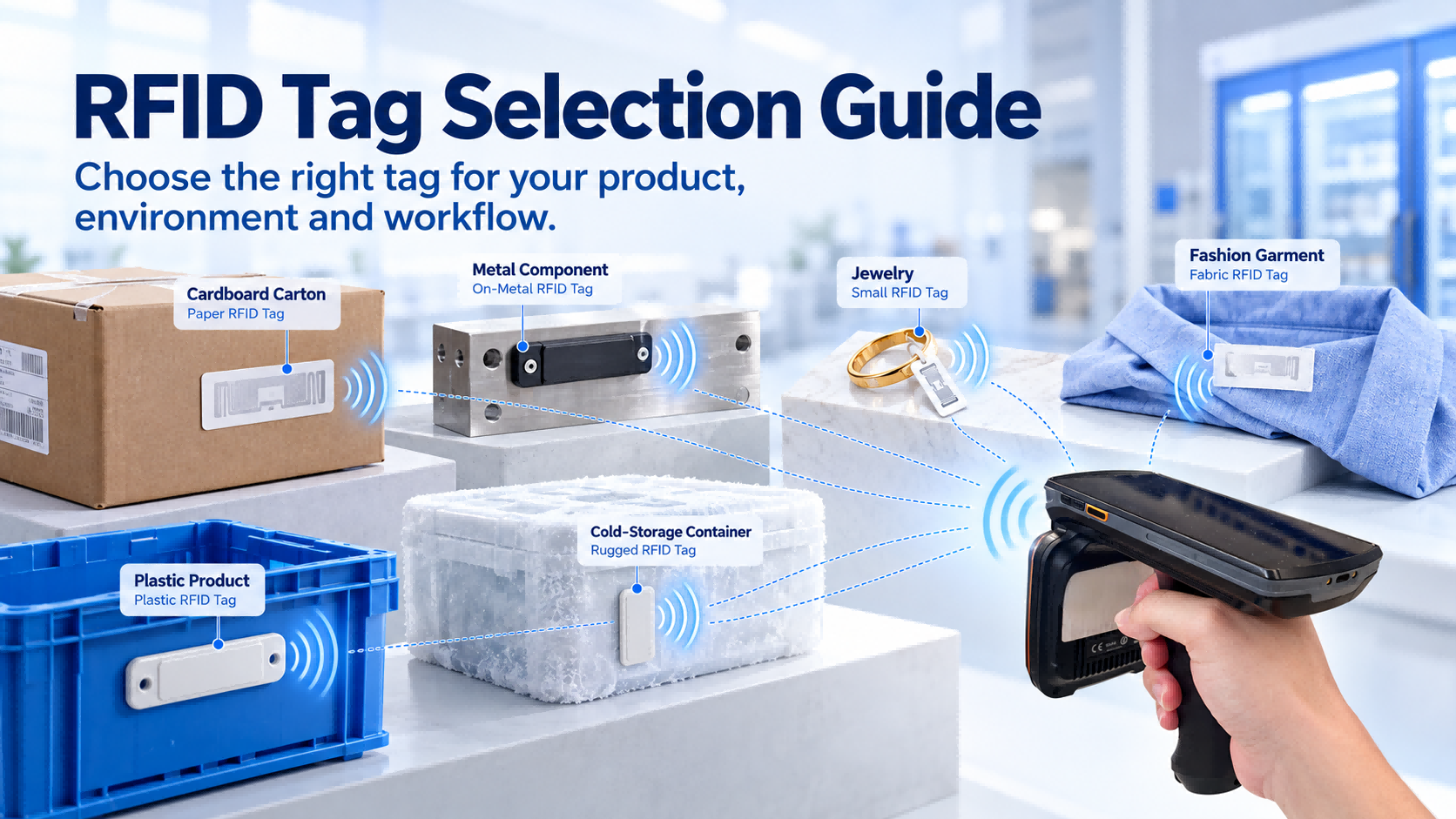
Metal product → start by evaluating an on-metal RFID tag
Cardboard carton → a standard UHF RFID label may be suitable
Jewelry → evaluate a compact tag designed for small items
Cold storage → evaluate both RFID performance and adhesive/material durability
Reusable asset → consider a durable reusable RFID tag
Retail apparel → balance tag size, appearance and reading performance
The final choice should still be verified through testing on the real product.
RFID Tag Selection in 4 Steps
1. Identify the product material
↓
2. Define the operating environment
↓
3. Set the required read distance and workflow
↓
4. Test suitable tags on the actual product
The correct sequence is:
Product → Environment → Workflow → Tag Type → Test
Not:
Datasheet → Bulk Order
Key Takeaways
There is no single RFID tag that works best for every product.
Metal, liquid, packaging, temperature and tag placement can significantly affect RFID performance.
A tag’s advertised read range does not guarantee the same result once attached to a product.
The RFID tag should be selected according to the business workflow, not only its technical specifications.
Sample testing on the actual item is strongly recommended before a large customized order.
Why Does the Same RFID Tag Perform Differently on Different Products?
RFID performance changes when the tag is attached to an object.
A tag that performs well in open-air testing may behave differently when it is:
attached directly to metal
placed near liquid
covered by packaging
surrounded by other tagged items
stacked with products
mounted in a different orientation
This happens because RFID performance depends on the complete operating environment, not only the tag itself.
A more useful way to think about performance is:
RFID Tag + Product + Packaging + Reader + Antenna + Distance + Orientation
For this reason, an advertised read distance should be treated as a reference rather than a guaranteed result for every application.
RFID Tags for Metal Products
For metal products, start by evaluating an on-metal or anti-metal RFID tag.
Standard RFID labels can perform poorly when attached directly to metal because the metal surface affects the RF field around the tag antenna.
At the Canton Fair, one customer managing metal sheet products was already using QR codes but wanted to reduce the need for employees to walk through the warehouse manually checking inventory. The project therefore required not only RFID software and readers, but also a suitable way to tag metal products.
What Should You Test on Metal?
Test the tag on the actual product and check:
metal type
tag position
tag orientation
attachment method
required reading distance
handheld or fixed-reader performance
product stacking conditions
A tag that works well on one isolated metal item may perform differently when many metal parts are stored close together.
Practical Rule
If the RFID tag will be attached directly to metal, do not assume a standard paper RFID label will perform correctly. Test an on-metal solution first.
RFID Tags for Cardboard Boxes and Packaging
For standard cardboard cartons, a conventional UHF RFID label is often a good starting point.
However, the material inside the carton still matters.
Before choosing a tag, first determine what you are actually tracking:
each individual item
the carton
both the item and carton
the pallet
A carton filled with clothing creates a different RFID environment from a carton filled with metal components or liquid products.
One fashion-related visitor at the Canton Fair specifically tested whether RFID tags could still be identified inside packaging and preferred smaller tag formats.
What Should You Test?
For carton applications, check:
label position
carton size
product material inside
number of tags inside the carton
stacking density
reading direction
required reading distance
Practical Rule
If the outer package is cardboard but the contents include metal or liquid, test the full packaged product—not just the empty box.
RFID Tags for Plastic Products
For many plastic products, a standard UHF RFID label may work well, but the product contents must still be considered.
Plastic itself is generally less problematic for RFID than metal.
However, a plastic bottle containing liquid creates a different environment from an empty plastic component.
When evaluating RFID tags for plastic items, consider:
what the product contains
tag placement
product stacking
packaging material
expected reading angle
Practical Rule
Do not select an RFID tag based only on the word “plastic.” Test the finished product in its normal storage or retail condition.
RFID Tags for Jewelry
For jewelry, start with compact RFID tags designed to balance small size with reliable identification.
Jewelry applications often require tags that are:
small
lightweight
visually unobtrusive
uniquely linked to individual products
suitable for rapid inventory counting
The challenge is that smaller does not automatically mean better.
A tag can look ideal on a jewelry item but still fail to provide the reading performance required for inventory counting.
FYJ also received jewelry-related RFID enquiries during the fair, including customers taking jewelry RFID tag samples for further evaluation.
What Should You Test?
Test jewelry RFID tags:
on the actual product
with neighboring jewelry items
in display trays
with the intended handheld reader
at realistic stocktaking distances
Practical Rule
Choose the smallest tag that still delivers the reading performance required by the workflow—not simply the smallest tag available.
RFID Tags for Cold Storage and Temperature-Changing Environments
For cold storage, evaluate the complete tag construction—not only the RFID chip.
One Canton Fair customer needed to attach RFID tags to components that would experience freezing conditions and later return to room temperature.
The question therefore was not simply:
“Does the RFID chip work at low temperature?”
The complete RFID label needs to be considered.
Important factors include:
adhesive performance
tag material
condensation
freezing and thawing cycles
attachment surface
repeated temperature changes
The electronics may still work while the adhesive or label material becomes the weak point.
Better Question
Instead of asking:
“Can this RFID tag work at -20°C?”
Ask:
“Can the complete RFID tag remain attached and readable throughout the full temperature cycle of our process?”
That is a much more useful qualification question.
RFID Tags for Fashion and Retail Products
For fashion retail, tag size, appearance and reading performance need to be considered together.
An RFID label may be:
attached to a hangtag
integrated into product packaging
used for stocktaking
used during checkout
used with RFID loss-prevention systems
Retail projects usually place more emphasis on the visual impact of the tag than industrial warehouse applications.
One fashion retail enquiry at the Canton Fair specifically preferred a smaller RFID tag while also testing whether products could still be identified inside packaging.
Practical Rule
For retail, do not optimize only for tag appearance. Confirm that the selected tag still performs correctly during inventory, checkout and other required workflows.
RFID Tag Selection Table
Product / Environment
Main Challenge
Tag Type to Evaluate
What to Test
Cardboard carton
Stacking and contents
Standard UHF RFID label
Position, distance, orientation
Metal product
RF interference
On-metal / anti-metal RFID tag
Mounting, spacing, distance
Jewelry
Small tag size
Compact RFID jewelry tag
Size, nearby products, readability
Cold storage
Temperature and adhesion
Low-temperature-compatible RFID tag
Adhesion, condensation, temperature cycling
Plastic product
Contents and stacking
Standard or application-specific UHF tag
Placement, contents, orientation
Fashion apparel
Appearance and size
Apparel RFID label / hangtag
Inventory, checkout, reading stability
Reusable asset
Long-term durability
Durable reusable RFID tag
Attachment, repeated use, environment
This table provides a starting point, not a final selection.
The actual tag should still be tested in the intended environment.
Item-Level, Carton-Level or Pallet-Level RFID?
The tracking level should be defined before selecting a tag.
Item-Level RFID
Each item receives a unique RFID tag.
Common applications include:
retail inventory
jewelry
asset tracking
item-level warehouse visibility
Carton-Level RFID
One RFID tag identifies the entire carton.
This is suitable when the carton is treated as one logistics unit.
Pallet-Level RFID
One identifier represents the pallet or shipping unit.
Some businesses use several levels at the same time:
Item RFID → Carton ID → Pallet ID
Practical Rule
Choose the tracking level first. Then select the RFID tag.
Otherwise, the tag may be technically suitable but wrong for the business process.
Does RFID Tag Size Affect Reading Distance?
Yes, tag antenna design and physical size can influence reading performance.
However, tag size is only one factor.
Actual performance also depends on:
antenna design
RFID chip
product material
tag placement
reader power
reader antenna
operating environment
This means:
Larger tag ≠ automatically better tag
A more practical question is:
“What is the smallest RFID tag that still meets the reading requirement on this specific product?”
How Far Can an RFID Tag Be Read?
There is no single read-distance answer that applies to all UHF RFID tags.
Actual distance depends on:
tag design
reader
antenna
reader power
tag orientation
product material
environment
A tag described as having a long reading distance may perform differently after being attached to metal, placed inside packaging or surrounded by other products.
For project evaluation, the important metric is not maximum laboratory distance.
It is:
reliable reading distance in the real workflow.
Why Should RFID Tag Samples Be Tested Before Bulk Ordering?
RFID tag samples should be tested before mass production whenever product material, packaging or operating conditions could affect performance.
This becomes especially important for customized or high-volume orders.
During the Canton Fair, some customers requested RFID tag samples for testing, while another enquiry involved approximately 100,000 customized RFID tags.
Before approving a large order, test:
actual product
actual packaging
intended reader
normal operating distance
actual storage conditions
realistic product movement
final tag placement
For metal, cold storage, liquids or dense stacking, testing becomes even more important.
Better Test Question
Do not ask only:
“Can the reader detect the tag?”
Ask:
“Can this tag be read reliably and repeatedly at the correct point in our actual workflow?”
8 Questions to Answer Before Choosing an RFID Tag
Providing these answers to an RFID supplier can speed up tag selection considerably.
1. What material is the product made of?
For example: cardboard, plastic, metal, fabric, glass or mixed materials.
2. Where will the tag be attached?
On the product, packaging, hangtag, metal surface or another location?
3. What is inside the packaging?
Metal and liquid can affect RFID performance even when the outer package is RFID-friendly.
4. What reading distance do you need?
Handheld inventory at close range and automatic gate reading may require different tag performance.
5. Will products be stacked closely together?
Dense storage can change the RF environment.
6. What temperature and humidity will the tag experience?
Include temperature changes, not just the lowest or highest temperature.
7. Is the tag disposable or reusable?
A long-term reusable asset tag has different requirements from a disposable retail label.
8. Are you tracking an item, carton or pallet?
This determines the level of identification required.
Common RFID Tag Selection Mistakes
1. Choosing Only by Advertised Read Distance
Maximum read distance does not guarantee the same result on your actual product.
2. Using a Standard RFID Label Directly on Metal
Evaluate an on-metal RFID tag instead.
3. Ignoring What Is Inside the Packaging
The carton may be RFID-friendly while its contents are not.
4. Choosing the Smallest Tag First
Small size should not come at the cost of unreliable reading.
5. Checking the Chip but Ignoring the Label Construction
Adhesive and material are especially important in cold, humid or changing environments.
6. Ordering Large Quantities Before Testing
A sample test is much cheaper than discovering a compatibility problem after mass production.
FAQ
What information should I provide when asking for an RFID tag recommendation?
Provide the product material, packaging, tag position, required reading distance, operating environment, reader type, approximate quantity and whether you are tracking an item, carton or pallet.
Can one RFID tag work for every type of product?
No.One tag may work across several similar applications, but metal, liquid, product size, packaging and operating conditions can require different tag designs.
Can normal RFID tags work on metal?
A standard RFID label may perform poorly when attached directly to metal. Start by evaluating an on-metal or anti-metal RFID tag.
Which RFID tag is suitable for cardboard cartons?
A standard UHF RFID label is often a suitable starting point, but the contents, stacking, tag position and required read distance should still be tested.
Can RFID tags be read through cardboard boxes?
Often yes. Cardboard itself generally does not block UHF RFID, but metal, liquids or dense products inside the carton can affect performance.
Can RFID tags work in cold storage?
Yes, provided the selected tag is suitable for the required environment. Test the chip, adhesive, material and complete temperature cycle.
What RFID tag should I use for jewelry?
Compact jewelry RFID tags are usually the first type to evaluate. Test them on the actual jewelry and in the intended display and inventory environment.
Does RFID tag size affect reading range?
It can. Antenna size and design affect performance, but product material, placement, reader configuration and environment are also important.
Should RFID tags be tested before mass production?
Yes, especially for metal, liquid, cold-storage applications, customized tags or high-volume orders.
Should I tag every item or only the carton?
Choose item-level tagging when individual visibility is required. Choose carton-level tagging when the carton is managed as one logistics unit.
Final Takeaway
The correct RFID tag is not selected from frequency and read range alone.
Start with four questions:
What is the product?
Where will the tag be used?
How does it need to be read?
What business process should the RFID tag support?
Then test the shortlisted tag on the actual product.
For cardboard cartons, a standard UHF RFID label may be the right starting point.
For metal products, evaluate an on-metal RFID tag.
For jewelry, prioritize a compact tag that still provides reliable reading.
For cold storage, test the complete label construction through the actual temperature cycle.
There is no universal RFID tag for every application.
The best RFID tag is the one that works reliably on your product, in your environment, for your workflow.
Read More


 en


 IPv6 network supported