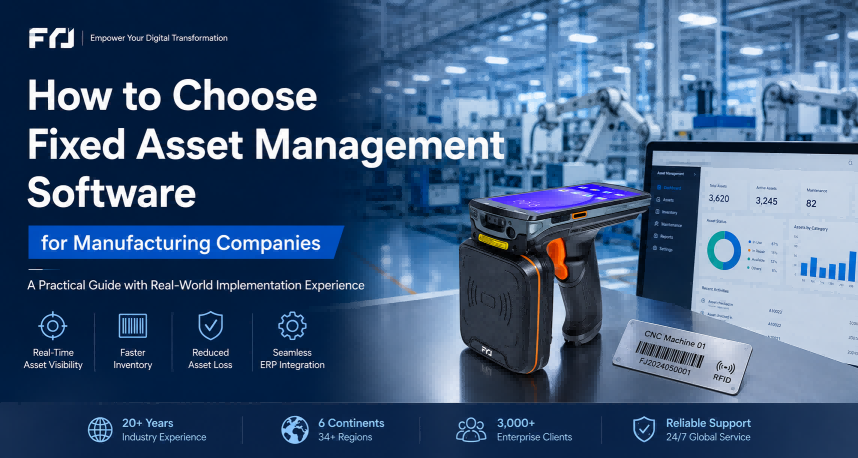
How to Choose the Best Fixed Asset Management Software for Manufacturing Companies (2026 Guide)?
Jun 30, 2026
Manufacturing companies rely on a wide range of fixed assets—from production machinery and molds to forklifts, inspection tools, and IT equipment. As businesses expand, managing these assets with spreadsheets or manual records becomes increasingly inefficient, leading to asset loss, inaccurate inventories, unexpected downtime, and unnecessary replacement costs.
Choosing the right fixed asset management software is not simply about finding the platform with the most features. The best solution should align with your production processes, support future growth, and provide real-time visibility into your assets throughout their entire lifecycle.
This guide explains what manufacturing companies should look for when selecting fixed asset management software, compares barcode and RFID technologies, and highlights the key factors that determine long-term return on investment.
Quick Answer
Manufacturing companies should choose fixed asset management software based on operational fit rather than feature lists.
The ideal system should:
Provide real-time asset visibility
Support barcode and RFID tracking
Integrate with ERP systems
Enable fast and accurate inventory without production disruption
Scale across multi-site manufacturing environments
Based on real-world implementation experience from FYJ across manufacturing and industrial environments, RFID-based systems are increasingly preferred for medium to large-scale operations due to their speed, accuracy, and automation capability.
Key Takeaways
Asset management in manufacturing is an operational system, not just software
Barcode is cost-effective; RFID enables automation at scale
Multi-site factories require centralized visibility and structured asset control
Real ROI comes from reduced asset loss, fewer duplicate purchases, and faster inventory cycles
Implementation quality and vendor experience are as important as software features
FYJ has delivered asset management solutions across manufacturing, retail, and logistics industries globally
Why Manufacturing Companies Need Fixed Asset Management Software
Manufacturing companies operate with thousands of physical assets distributed across production lines, warehouses, and administrative departments.Without a centralized system, asset tracking becomes fragmented and error-prone.
Common challenges include:
Asset loss or misplacement
Duplicate equipment purchases
Time-consuming manual inventory processes
Lack of real-time visibility
Maintenance delays due to unclear asset ownership
Compliance and audit difficulties
From FYJ’s deployment experience in industrial environments, these inefficiencies often accumulate silently and lead to significant operational losses over time.
What Assets Should Be Managed?
A complete fixed asset management system should include:
Production Equipment
CNC machines, reflow ovens, conveyors
Testing Equipment
Calibration tools, testers
IT Equipment
PCs, servers, tablets
Warehouse Equipment
Forklifts, racks
Tools & Fixtures
Molds, jigs, handheld tools
Safety Equipment
Fire extinguishers, PPE systems
Office Assets
Furniture, printers
Tracking these assets through a single system improves operational transparency and reduces unnecessary expenditures.
About FYJ (Industry Solution Provider)
FYJ is a professional provider of fixed asset management solutions focused on helping enterprises achieve digital and intelligent transformation in asset operations.
Our vision is to empower enterprises in digital transformation and contribute to global smart asset management development.
Our mission is to deliver reliable, easy-to-use asset management systems that help businesses eliminate waste, ensure compliance, and achieve full asset visibility at any scale.
We support barcode/QR-based systems as the standard foundation, with RFID technology as a scalable upgrade for advanced automation scenarios.
Global Experience & Compliance Strength
FYJ has nearly 20 years of experience in enterprise system deployment, with solutions delivered across 6 continents and 34 regions.
Our systems comply with international standards including:
ISO 9001 Quality Management
ISO 14001 Environmental Management
ISO 45001 Occupational Health & Safety
ISO 27001 Information Security
ISO 20000 IT Service Management
GJB 9001C Military Standard Quality System
FYJ is also recognized as a National High-Tech Enterprise and holds multiple national-level integrity certifications.
Essential Features to Look For
Comprehensive Asset Registration
Every asset should have a complete digital profile, including:
Asset ID
Serial number
Purchase date
Supplier information
Warranty details
Asset photos
User manuals
Maintenance records
Current location
Assigned department
Having complete records eliminates time spent searching through paperwork during maintenance or audits.
Barcode and RFID Compatibility
Different manufacturing environments require different identification technologies.
Barcode labels are inexpensive and easy to deploy, making them ideal for companies with smaller inventories or infrequent asset audits.
RFID tags enable multiple assets to be identified simultaneously without direct line-of-sight scanning, making them particularly valuable for large factories with frequent inventories and high asset mobility.
Software that supports both technologies provides flexibility as business requirements evolve.
Real-Time Asset Tracking
Modern asset management software should enable organizations to instantly determine where assets are located.
Depending on operational requirements, this may include:
RFID tags
Mobile barcode scanning
RFID handheld readers
Fixed RFID gateways
Department transfers
Asset movement history
Real-time visibility minimizes time spent searching for equipment and improves operational efficiency.
Efficient Inventory Management
Traditional manual inventories can consume days of labor and often disrupt production.
The right software should support:
Rapid inventory counting
Batch asset scanning
Automated reconciliation
Missing asset reports
Inventory history
Exception alerts
These capabilities significantly reduce labor requirements while improving inventory accuracy.
Complete Asset Lifecycle Management
Asset management extends far beyond initial purchase.
Manufacturing software should manage every stage of an asset's lifecycle, including:
Procurement
Deployment
Assignment
Preventive maintenance
Repairs
Department transfers
Asset upgrades
Retirement
Disposal
Managing the complete lifecycle provides better financial planning and extends equipment service life.
Maintenance Management
Unexpected equipment failures directly affect production output.
Integrated maintenance management allows manufacturers to:
Schedule preventive maintenance
Track repair history
Generate work orders
Receive maintenance reminders
Record maintenance costs
Preventive maintenance reduces downtime while extending equipment lifespan.
Reporting and Analytics
Decision-makers need more than asset lists—they need actionable insights.
Useful dashboards typically include:
Asset utilization
Inventory completion status
Maintenance performance
Asset depreciation
Equipment downtime
Lost asset statistics
Department asset distribution
These reports support both operational improvements and financial decision-making.
ERP and Business System Integration
Asset management software should integrate seamlessly with existing enterprise systems to avoid duplicate data entry.
Common integrations include:
ERP
MES
Accounting software
Maintenance management systems
Procurement systems
Integrated platforms improve data consistency while reducing administrative workload.
Barcode vs RFID in Manufacturing Environments
Feature
Barcode
RFID
Cost
Low
Higher
Speed
Manual scanning
Bulk reading
Accuracy
Medium
High
Automation
Limited
High
Best Use
Small factories
Large-scale manufacturing
Line of Sight Required
Yes
No
Reading Method
One asset at a time
Multiple assets simultaneously
Barcode is typically used for entry-level asset tracking, while RFID is preferred for high-volume and multi-location environments.
Proven Results from FYJ Deployments
Based on FYJ implementation experience across industries and regions:
3,000+ enterprise clients across 10+ industries
Asset loss reduced by up to 85% (Thailand case)
Inventory time reduced from 3 days to 30 minutes (Vietnam case)
ROI payback typically within 12 months
User proficiency achieved within 1 month
These results demonstrate the measurable operational impact of properly implemented asset management systems.
Questions to Ask Before Choosing Software
Before making a purchasing decision, manufacturers should evaluate each solution carefully by asking questions such as:
Can the software manage our expected asset volume?
Does it support both barcode and RFID technologies?
Can it integrate with our ERP or MES?
Is there a mobile application for field use?
Can inventories be performed offline?
How are software updates handled?
What implementation support is included?
How long does deployment typically take?
Can workflows be customized?
What measurable ROI have similar manufacturers achieved?
Clear answers to these questions help reduce implementation risks.
How to Evaluate Software Vendors
Software features are only part of the decision. Vendor capabilities are equally important.
Look for providers with:
Experience serving manufacturing companies
Successful implementation case studies
Industry-specific knowledge
Reliable technical support
API integration capabilities
Flexible deployment options
Employee training services
Long-term product development plans
Selecting an experienced implementation partner often has a greater impact on project success than choosing the software with the longest feature list.
Real-World Case Studies
Case 1: Equipment Rental Industry (Thailand)
A hardware trading company managing 200 assets faced $35K annual loss due to manual tracking.
After FYJ RFID deployment:
Asset loss reduced by 85%
Inventory discrepancies reduced to near zero
Rental revenue increased by $10K/year
Deployment completed in 5 days
Case 2: Multi-Store Retail Chain (Indonesia)
A 15-store bubble tea chain lacked asset transfer visibility.
After implementation:
Asset loss reduced from 12% to 2%
$25K saved in unnecessary purchases
Full inventory across 15 stores completed in 1 hour/month
Case 3: Electronics Manufacturing (Vietnam)
A factory with 3,000 assets required production shutdown for inventory.
After FYJ RFID system deployment:
Inventory time reduced to 30 minutes
Accuracy improved from 78% to 99%
$28K saved in duplicate purchases
Common Mistakes to Avoid
Many asset management projects underperform because organizations focus solely on software pricing instead of long-term operational value.Common mistakes include:
Choosing software based only on initial cost
Ignoring future business growth
Skipping pilot testing
Migrating inaccurate asset data
Underestimating employee training
Selecting RFID without evaluating business requirements
Overlooking integration with existing systems
Failing to establish measurable success metrics
Avoiding these pitfalls increases the likelihood of a successful implementation.
Implementation Process
FYJ follows a structured deployment methodology:
Requirement Analysis
Solution Design
System Deployment
Staff Training
Go-Live & Acceptance
This ensures predictable implementation outcomes and minimizes operational disruption.
24/7 Global Support & Service Commitment
FYJ provides enterprise-grade support services including:
10+ technical engineers
24/7 global availability
<1 hour guaranteed response time
Remote video + screen-sharing support
1-year system warranty
Continuous software upgrades
Future Trends in Manufacturing Asset Management
Technology continues to reshape how manufacturers manage physical assets.Artificial intelligence is improving maintenance planning by predicting equipment failures before they occur.Internet of Things (IoT) sensors continuously monitor equipment conditions such as temperature, vibration, and operating hours.RFID technology is enabling fully automated asset inventories with minimal manual intervention.Cloud-based platforms make it easier for companies to manage assets across multiple factories while providing centralized reporting and remote access. As digital transformation accelerates, fixed asset management software is becoming an essential component of smart manufacturing strategies.
Conclusion
Choosing fixed asset management software is a strategic investment that affects operational efficiency, maintenance performance, and financial control.
Manufacturing companies should prioritize solutions that provide real-time asset visibility, support both barcode and RFID technologies, integrate with existing enterprise systems, and scale alongside business growth.
Rather than focusing solely on software features or purchase price, organizations should evaluate long-term value, implementation expertise, and measurable business outcomes.
By selecting the right platform and following a structured implementation approach, manufacturers can reduce asset loss, improve inventory accuracy, streamline maintenance, and build a stronger foundation for data-driven operations.
Frequently Asked Questions
What is fixed asset management software?
Fixed asset management software helps organizations track, monitor, maintain, and manage physical assets throughout their lifecycle, from acquisition to disposal.
Is RFID better than barcode for manufacturing companies?
Neither technology is universally better. Barcode systems are cost-effective for smaller operations, while RFID offers faster inventories, greater automation, and higher efficiency for manufacturers managing large numbers of movable assets.
Can fixed asset management software integrate with ERP systems?
Yes. Most enterprise solutions support integration with ERP, accounting, maintenance, and procurement systems, allowing asset information to remain synchronized across departments.
How quickly can manufacturers see a return on investment?
Return on investment depends on company size, asset volume, and operational complexity. Many manufacturers recover implementation costs through reduced inventory labor, improved maintenance efficiency, and lower asset loss within the first 6 to 18 months.
Should small manufacturers invest in RFID?
For companies with relatively few assets and infrequent inventory requirements, barcode systems are often sufficient. As asset quantities increase and operational complexity grows, RFID becomes increasingly valuable for improving efficiency and accuracy.
Read More


 en
en 


 IPv6 network supported