

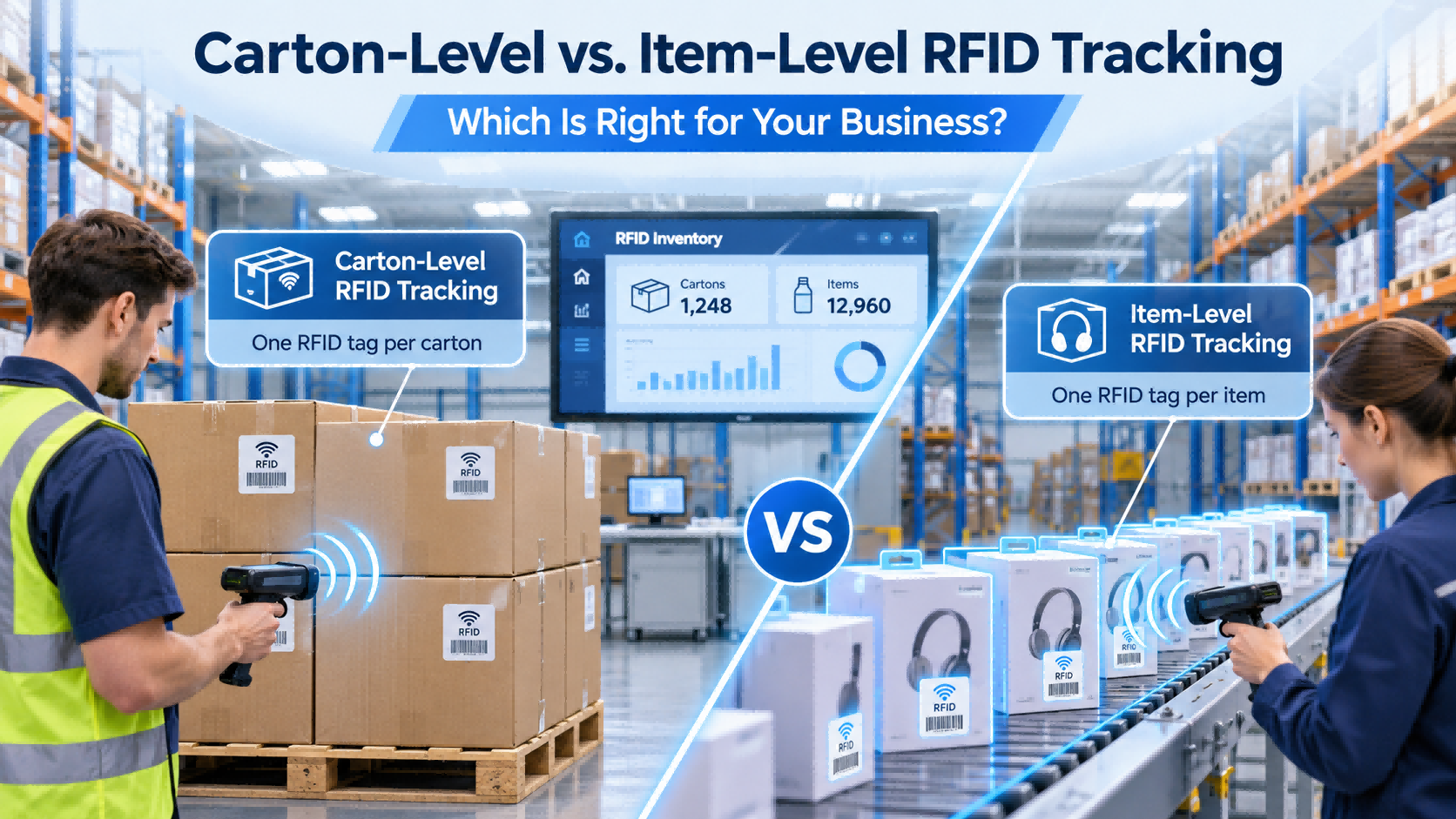
Tag the smallest unit your workflow needs to identify. If you ship sealed cartons, start with carton tags. If you pick loose parts, first decide whether you need to record how many pieces moved or exactly which pieces moved.
| How staff handle the goods | What the warehouse needs to verify | Approach to test |
| Receive and ship sealed cartons | Which cartons arrived or shipped | Carton-level RFID |
| Pick sealed inner packs from an outer carton | Which packs were picked and how many pieces they represent | Inner-pack RFID |
| Pick interchangeable pieces from an open carton or bin | How many pieces moved and how many remain | Carton or bin identification plus quantity recording |
| Track individual products through issue, shipment, or return | Exactly which units moved | Item-level RFID |
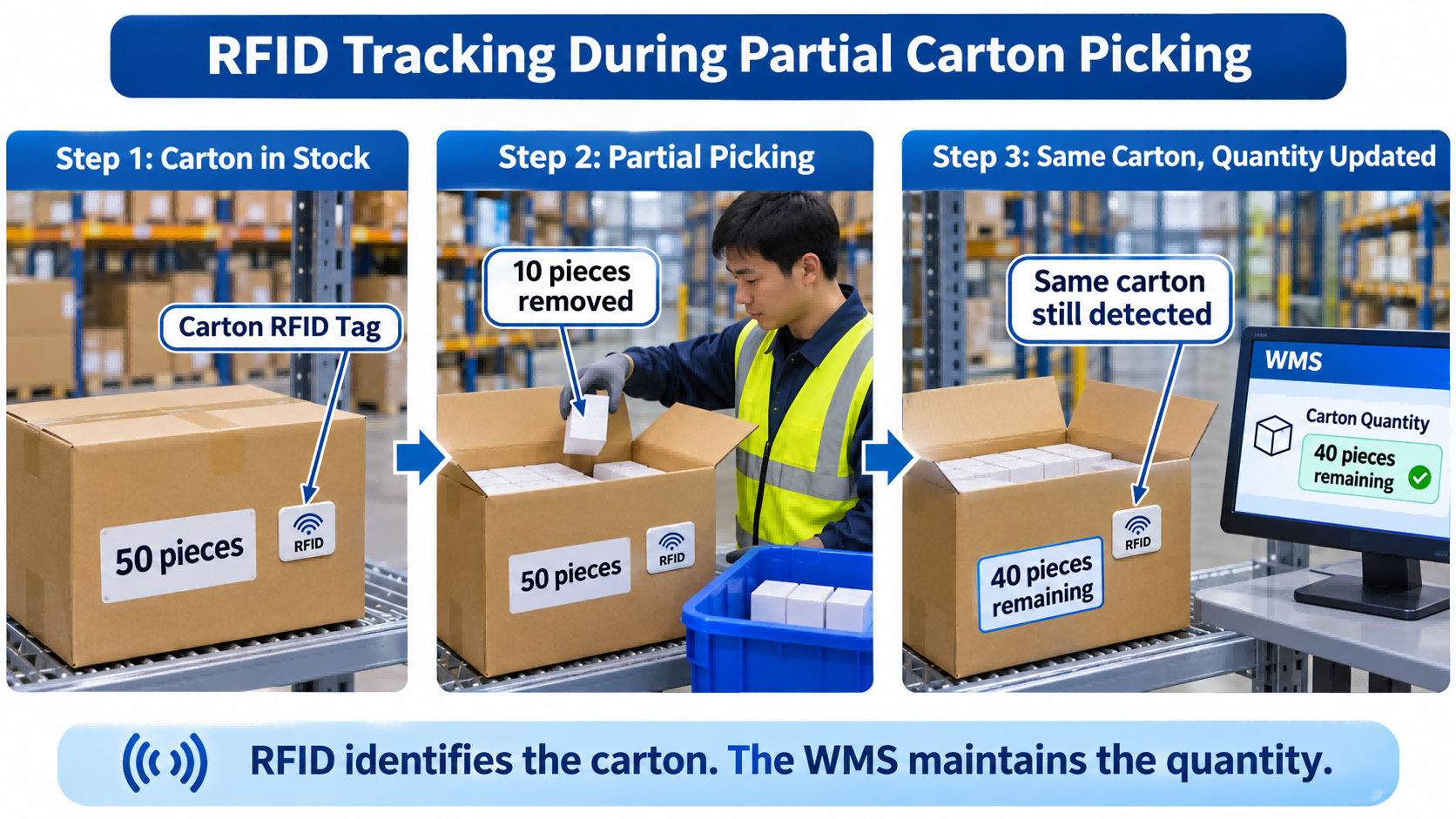
A carton tag identifies a specific carton. Your warehouse management system (WMS) can link it to a product and a recorded packing quantity. If staff open the carton and remove untagged pieces, If staff remove untagged pieces, the physical quantity drops immediately. The WMS balance changes when the withdrawal is recorded.
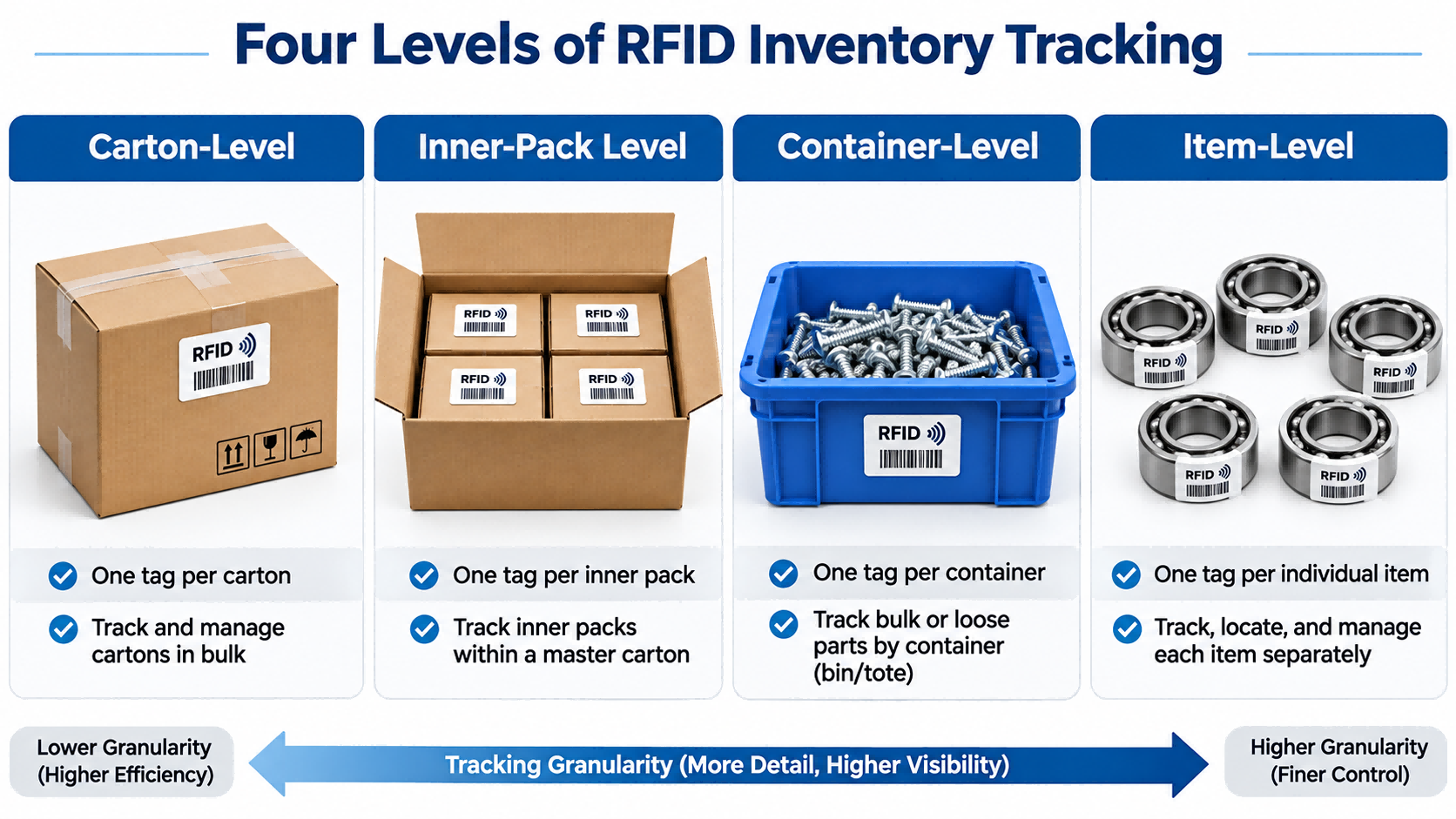
Consider an automotive and motorcycle parts warehouse. It ships cable assemblies by the carton, mounting clips by the pack, and washers by the piece. It also needs to trace individual replacement motors. Each product calls for a different level of identification.
A wholesale order calls for two cartons of cable assemblies, each recorded as containing 50 pieces. At dispatch, the team verifies the two carton IDs against the order. The WMS can then record 100 pieces shipped based on the packing quantity assigned to each carton.
That process depends on the cartons remaining intact and the packing records being accurate. If an employee ships one full carton and 20 loose assemblies, the loose pieces need a separate quantity entry.
For the next step in this workflow, see FYJ’s guide to how RFID gates record warehouse entry and exit.
An outer carton contains ten sealed packs of ten mounting clips. Staff normally pick one or two packs at a time. Giving each inner pack an RFID tag lets the warehouse identify what staff actually pick. The WMS converts two confirmed packs into 20 pieces using the recorded pack size.
This approach works while the inner pack remains the picking unit. If staff regularly open those packs to fill smaller orders, define how they will record the loose pieces as well.
A bin holds 60 identical washers. An operator identifies the bin, picks 12, and confirms the quantity against the order. The WMS should show 48 washers remaining in that bin.
Reading the bin tag during stocktaking brings up the recorded balance. Staff verify the physical quantity using their agreed counting method. If the 12-piece pick was never confirmed, reading the bin again will still bring up the old balance.
Where picked stock moves to a staging area before shipping, distinguish the quantity left in the bin from the total quantity still on site. Those are two different figures.
The warehouse wants to match returned motors to the exact units it originally shipped. Two motors can share a SKU while carrying different individual IDs. Capturing those IDs at dispatch allows staff to check a returned motor against its shipment record.
This is where item-level RFID can add value. If staff need to verify specific units, the pilot should show that the system reads the expected IDs and gives staff a clear way to handle a missed read or an unexpected unit.
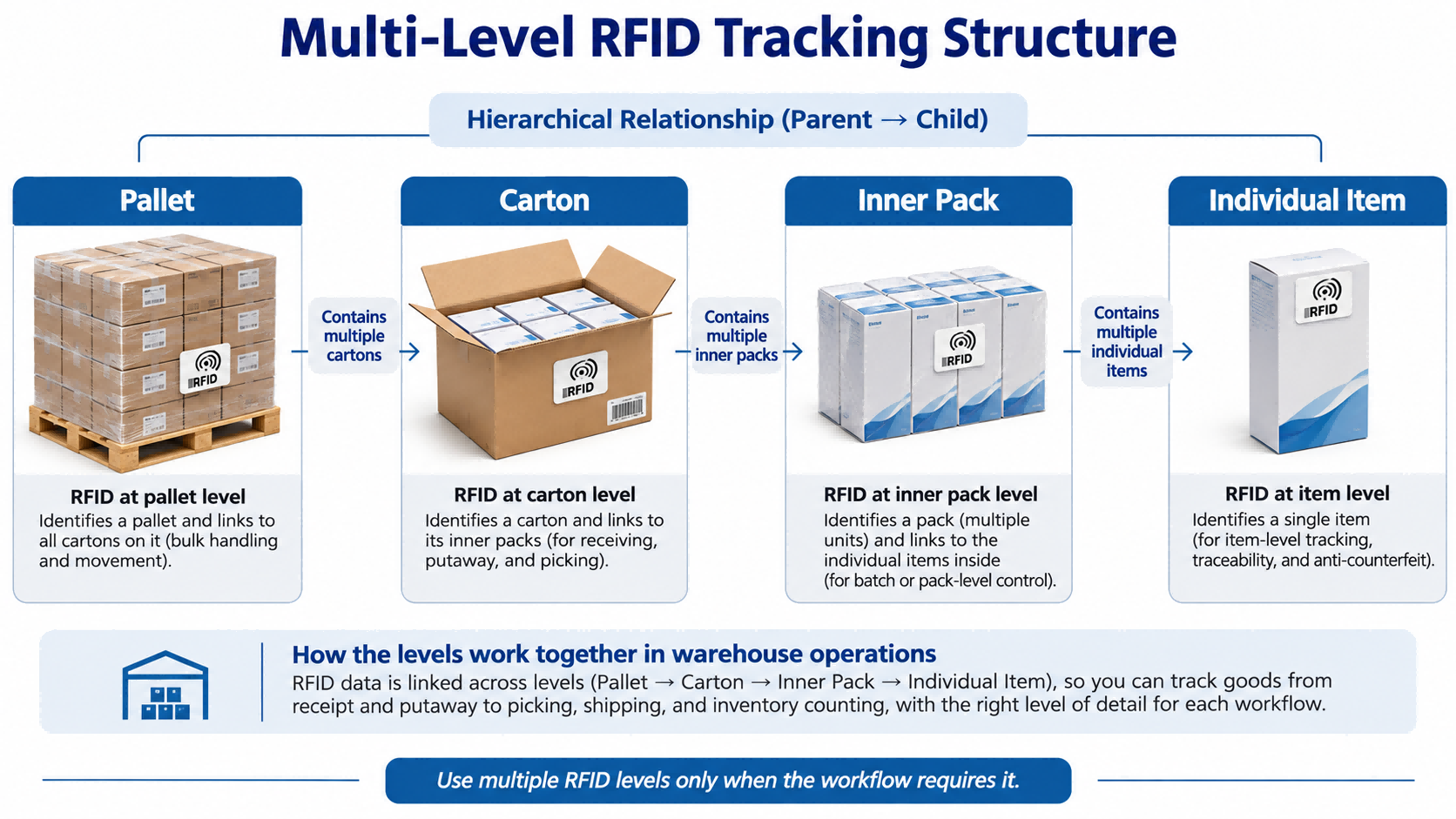
Suppose you have 10,000 pieces, packed 50 to a carton, with five sealed inner packs of 10 pieces in each carton. If you tag at only one level, the label count looks like this:
| Tracking level | One tag per | Tags required |
| Carton level | 50 pieces | 200 |
| Inner-pack level | 10 pieces | 1,000 |
| Item level | 1 piece | 10,000 |
This table compares label quantities. When comparing project costs, also consider label type, application and encoding time, software changes, and the work involved in handling exceptions.
Carton tagging can be efficient for a product that ships sealed. For a product picked loose every day, include the time staff spend confirming partial picks and reconciling discrepancies. For metal parts or tightly packed items, test RFID performance with the carton loaded as it would be in daily operations. A successful read on a single part at a workbench tells you little about how a full carton will read.
Use both levels when each supports a separate step. For example, receiving staff may verify sealed cartons, while the service team later issues and tracks individual motors.
Define which record drives the inventory update at each step. If a reader detects the carton tag and the tags on its contents in one pass, the WMS should count the underlying stock once. If a worker moves a motor from Carton A to Carton B, the software needs to reflect that change before anyone relies on the carton record to verify what is inside.
Before adding a second label, identify who confirms the packing relationship, when they update it, and how they verify it after repacking.
Start with a few SKUs that represent how your team works. Use the products, packaging, and equipment that staff will handle after rollout. For each test, compare what physically moved, what the reader detected, and what the WMS recorded.
| Pilot test | Expected result |
| Receive and ship a sealed carton | The expected carton ID and its recorded packing quantity appear against the correct transaction. |
| Pick two sealed inner packs of 10 | The WMS records the two intended packs and converts the pick to 20 pieces. |
| Pick 12 pieces from a bin holding 60 | The source bin shows 48 pieces after confirmation. Reading it again does not create a second deduction. |
| Return part of a pick | Once accepted, the returned quantity is added to the intended stock location. |
| Read individually tagged units in their normal packaging | The detected IDs are checked against a verified list. Staff can identify and resolve any missed or unexpected reads. |
| Repack an item from one tagged carton to another | The item appears under the new carton and is counted once. |
| Read the same tags repeatedly during one movement | The system records the intended transaction once. |
For an open carton or bin, repeat the stocktake after a partial pick. If the reader finds the correct bin but the WMS still shows the original quantity, check whether the pick was confirmed against the correct source record. That tells you where to investigate before changing the RFID setup.
Can one RFID tag count every piece inside a carton?
A carton tag identifies the carton. The WMS can display the packing quantity associated with it. If someone removes untagged pieces, the balance must be updated through a picking or stock adjustment process.
Do I need item-level RFID if I pick by piece?
If you only need to know how many interchangeable pieces were picked, identifying the source carton or bin and confirming the quantity may be enough. Test item-level RFID if you need to identify specific units or want to count individually tagged stock.
Is carton-level RFID cheaper than item-level RFID?
It usually requires fewer labels. Compare the total workload, including partial picks, quantity checks, and stock corrections. The lower label count offers the clearest benefit when cartons remain intact through receiving, storage, and dispatch.
Can one warehouse use different RFID tracking levels?
Yes. A warehouse can track one SKU by carton, another by inner pack, and another by individual unit. If the same goods carry tags at multiple levels, define which record updates inventory and how staff record packing changes.
Choose one product your team handles regularly. Follow it from receiving to dispatch and note the first point where staff open the packaging. At that point, what do they need to confirm: the pack ID, the quantity picked, or the identity of each piece?
For an initial assessment with FYJ, share three details:
FYJ can use those details to help you choose a tracking level to test and define what the pilot should verify before you roll it out.
Hi! Click one of our members below to chat on
 en


 IPv6 network supported