


An automotive spare parts warehouse may contain thousands of different products, from brake levers and mirrors to electronic controllers, motors, batteries and small mechanical components.
Many of these products look similar but have different part numbers, specifications or compatibility requirements.
When inventory is managed through Excel spreadsheets, manual records or barcode scanning alone, keeping stock information accurate can become increasingly difficult as the product range grows.
A wrong part number, an incorrect storage location or an unrecorded stock movement can lead to picking errors, delayed orders and unnecessary inventory costs.
So, how can automotive spare parts businesses improve inventory visibility without making warehouse operations more complicated?
RFID inventory management provides another way to identify products, record stock movements and support faster inventory counting.
By combining RFID tags, handheld readers, fixed reading devices and warehouse management software, businesses can build a more structured process covering receiving, storage, picking, shipping and stock control.
This guide explains how RFID can be applied to automotive and motorcycle spare parts warehouses, what needs to be considered when tagging different products, and how to plan an RFID inventory management system.
RFID inventory management uses radio frequency identification to identify tagged products, cartons or storage containers and connect their identification data with warehouse records.
A typical automotive spare parts RFID system includes:
Warehouse Management Software (WMS): Manage part numbers, quantities, storage locations, stock movements and inventory alerts.
The basic workflow is:
Product Registration → RFID Tagging → Receiving → Put away → Inventory Counting → Picking → Shipping → Stock Control
However, not every spare part needs an individual RFID tag.
The appropriate tagging method depends on the product material, packaging, handling unit and level of inventory visibility required.
Automotive spare parts warehouses have some inventory management challenges that are different from ordinary warehouses.
The difficulty is not simply the number of products. It is the variety of products and the level of identification required.
A spare parts distributor may manage thousands of SKUs covering different vehicle brands, models and specifications.
For example, two brake levers may look almost identical but have different part numbers and vehicle compatibility.
Without accurate product identification, employees may select the wrong item during picking.
A warehouse system needs to connect each physical product with the correct part number and product record.
Automotive and motorcycle spare parts are not uniform.
A warehouse may contain:
Some products are individually packaged, while others are stored in bulk or handled without individual packaging.
This makes a single tagging method unsuitable for every SKU.
When products are stored across multiple shelves and warehouse zones, employees may spend considerable time locating the correct parts.
In some warehouses, experienced employees remember where products are stored, while new employees rely on paper records or spreadsheets.
A structured location management system can connect product records with warehouse zones, shelves and bin locations.
Products may be received, moved, picked, returned or shipped throughout the day.
If these movements are not recorded correctly, the system inventory may no longer match the physical stock.
This can result in:
Traditional barcode inventory counting requires employees to locate products and scan their labels individually.
For warehouses with thousands of spare parts, this can become a time-consuming task.
RFID provides an alternative by allowing compatible readers to identify multiple tagged products within a reading area, reducing the need for individual barcode scanning.
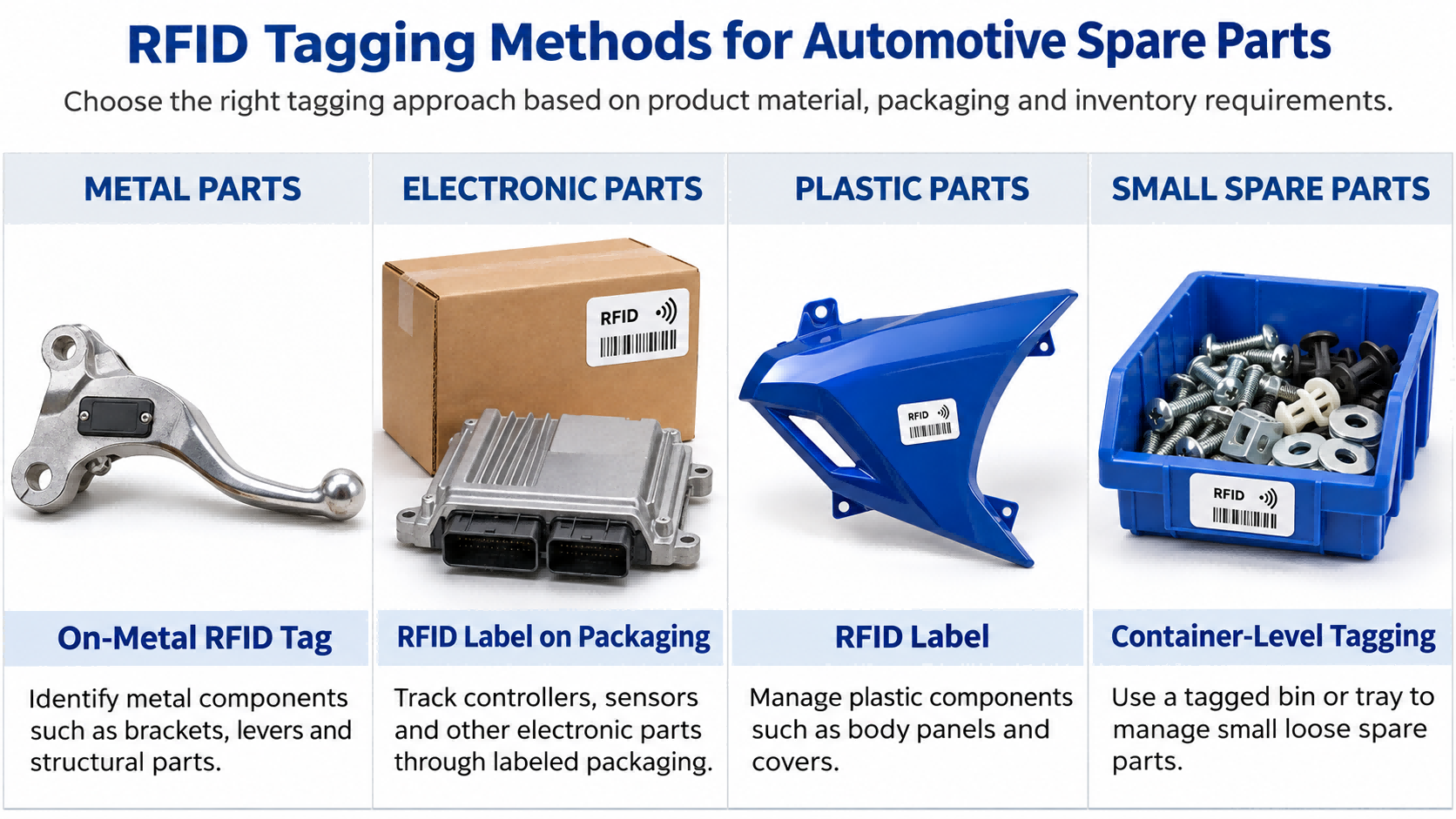
Before introducing RFID, businesses should classify their products according to material, packaging and inventory requirements.
Not every automotive spare part should be tagged in the same way.
| Product Type | Examples | RFID Approach to Evaluate |
| Metal components | Brackets, levers, mechanical fittings | On-metal RFID tags |
| Electronic components | Controllers, sensors | RFID labels on suitable surfaces or packaging |
| Plastic components | Body panels, covers | Standard UHF RFID labels where suitable |
| Large components | Motors, selected equipment | Suitable product or packaging-level tags |
| Small accessories | Cables, clips, fasteners | Inner-pack, bin or container-level tracking |
| Packaged spare parts | Boxed accessories and components | Carton-level RFID |
The final tag selection should be tested against the actual product and storage environment.
Metal surfaces can affect the antenna performance of conventional UHF RFID tags.
For components that require direct identification on metal surfaces, an on-metal RFID tag may be a suitable option.
The tag design, dimensions, mounting position and required reading distance should all be considered.
For products already stored in cardboard boxes or other suitable packaging, RFID labels may be attached to the packaging instead of the metal product itself.
This can be practical when the warehouse receives and ships products by carton.
However, carton-level identification does not automatically identify untagged products inside an opened carton.
Some automotive accessories are too small or too numerous to justify individual tagging.
For products such as clips, fasteners and small fittings, a tagged bin, tray or container may be more practical.
The RFID identifier represents the container, while the software maintains the product type and recorded quantity.
This can reduce tagging work while providing a structured way to manage small-part inventory.
The key is to choose the tracking unit according to how products are actually received, stored and picked.
An RFID tag alone does not tell warehouse employees which spare part it represents.
The RFID identifier must be linked to the corresponding product information in the warehouse management system.
For automotive spare parts, important product information may include:
For example:
| RFID Identifier | Part Number | Product | Location |
| EPC001 | BRK-001 | Brake Lever A | A-01-02 |
| EPC002 | MIR-015 | Rearview Mirror B | A-01-05 |
| EPC003 | CTL-008 | Motor Controller C | B-02-01 |
Each RFID identifier is associated with its corresponding product or handling-unit record.
For item-level tracking, individual products can have unique RFID identities.
For carton-level tracking, the RFID identifier represents the carton, which is linked to its product and recorded quantity.
This distinction is important because the RFID data structure should match the warehouse's actual inventory management method.
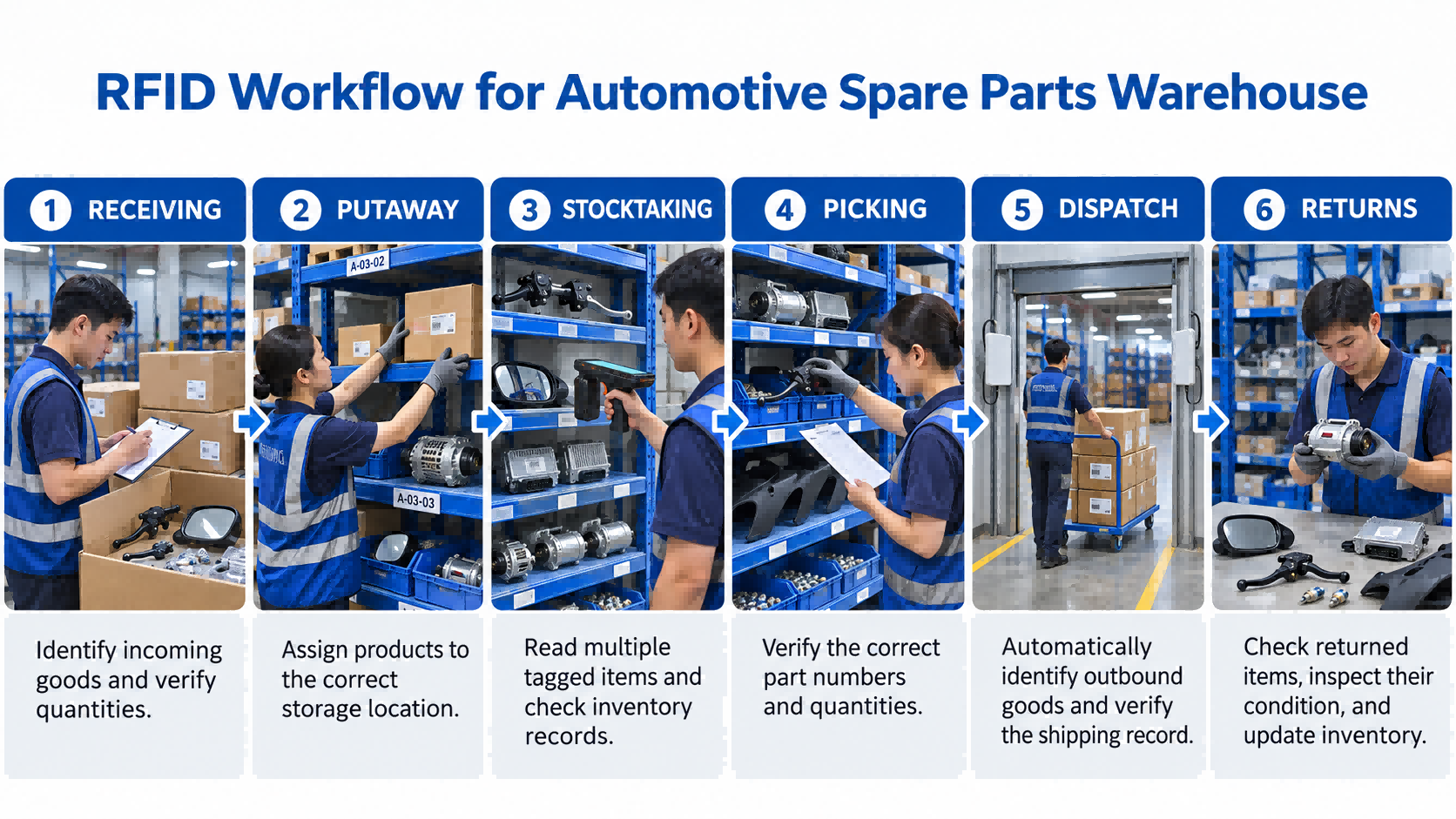
Receiving is the first important stage in spare parts inventory management.
When new goods arrive, warehouse employees need to verify the products, quantities and corresponding part numbers.
A typical RFID receiving process can include the following steps.
Before receiving, the warehouse system should contain the relevant product records.
These may include part numbers, descriptions, product categories and expected quantities.
Where RFID tagging is required, an RFID printer can encode the tag identifier and print the corresponding product information.
Depending on the tagging strategy, labels can be prepared for individual items, cartons or containers.
Employees attach the appropriate tags to products or packaging.
For metal components, suitable on-metal tags should be evaluated.
For packaged products, RFID labels may be attached to cartons or other suitable packaging.
Employees use an RFID handheld PDA to read the tagged products or handling units.
The system compares the identified goods with the expected receiving records.
Any quantity differences or unidentified products can be handled through the configured receiving process.
After verification, the receiving record is confirmed and the products become available for the next warehouse operation.
This helps create a more structured receiving process and reduces reliance on manual record entry.
After receiving, spare parts need to be assigned to appropriate storage locations.
For warehouses with many SKUs, location management is just as important as product identification.
A typical warehouse location structure may include:
Warehouse → Zone → Shelf → Bin
For example:
The WMS links the product or tagged handling unit to its assigned storage location.
During putaway, employees can use an RFID PDA to verify the product and confirm its designated location through the software workflow.
When products are moved, the corresponding location records should also be updated.
RFID does not automatically determine the exact shelf location simply because a tag is readable. Accurate location management requires an appropriate location confirmation process or suitable reading infrastructure.
This is particularly important in large spare parts warehouses where similar-looking products may be stored in different areas.
Inventory counting is one of the most practical applications of RFID in spare parts warehouses.
With barcode-based stocktaking, employees normally need to locate and scan products individually.
With RFID, compatible handheld readers can identify multiple tagged items during a reading session.
A typical inventory process may look like this:
Select Inventory Task → Choose Warehouse Location → Read RFID Tags → Compare System Records → Review Differences → Confirm Inventory
The RFID PDA reads the identifiers of products or handling units within its reading area.
The WMS compares the identified records with the expected inventory.
Employees can then review:
For warehouses containing large numbers of tagged products, RFID can reduce the need for individual visual barcode scanning.
It may also make inventory verification more convenient when products are stored in boxes, bins or other handling units.
However, actual performance depends on:
For metal spare parts, testing is especially important because nearby metal surfaces and stacked components can affect reading performance.
After inventory is recorded, the next challenge is ensuring that the correct spare parts are picked and shipped.
A warehouse may receive an order containing multiple part numbers and quantities.
For example:
| Part Number | Product | Order Quantity |
| BRK-001 | Brake Lever A | 20 |
| MIR-015 | Rearview Mirror B | 10 |
| CTL-008 | Motor Controller C | 5 |
Employees need to identify the correct products and quantities before shipping.
With RFID-supported picking, employees can use a handheld PDA to verify tagged products against the picking task.
The software can compare the identified RFID records with the order information.
If the wrong tagged product is selected, the system can provide an exception prompt according to the configured rules.
Before shipping, the warehouse can verify the products or cartons against the outbound order.
For operations that require more automation, fixed RFID readers or RFID gates can be installed at designated shipping checkpoints.
These devices can capture RFID tag information as goods pass through the reading area.
The software then processes the captured data according to the configured outbound workflow.
For example:
RFID Tag Detected → Order Verification → Outbound Record → Inventory Update
A properly configured system can also generate alerts when detected goods do not match the expected shipping information.
The accuracy of movement records depends on reader placement, reading-zone design, transaction rules and exception handling.
Spare parts businesses need to maintain enough inventory to fulfill orders without holding unnecessary stock.
Some parts move quickly, while others may remain in storage for longer periods.
A warehouse management system can help monitor stock quantities and identify products that require replenishment.
For example:
| Part Number | Current Stock | Minimum Stock | Status |
| BRK-001 | 120 | 50 | Normal |
| MIR-015 | 18 | 30 | Replenishment Needed |
| CTL-008 | 8 | 20 | Replenishment Needed |
When the recorded quantity falls below the configured minimum stock level, the system can generate an alert.
This helps purchasing and warehouse teams identify products that may need replenishment.
RFID supports the identification and recording of inventory movements, while the WMS applies stock thresholds and replenishment rules.
The two work together to improve inventory visibility.
Not necessarily.
The most practical RFID implementation does not always involve tagging every individual product.
Different spare parts may require different tracking levels.
| Inventory Type | Suggested Tracking Level |
| High-value individual components | Item-Level |
| Individually managed motors and equipment | Item-Level |
| Sealed cartons of spare parts | Carton-Level |
| Small packaged accessories | Inner-Pack Level |
| Loose screws, clips and fasteners | Container-Level |
| Mixed warehouse inventory | A combination of tracking levels |
For example, a distributor may individually track high-value electronic components while managing small fasteners through tagged bins.
This approach avoids unnecessary tagging work and allows the business to focus on products where individual identification provides the greatest operational value.
The decision should be based on product value, picking frequency, packaging, material and inventory requirements.
Many automotive parts distributors already use ERP, WMS or other inventory management systems.
Introducing RFID does not necessarily mean replacing the existing software.
There are different integration approaches.
RFID data can be transferred to an existing ERP, WMS or other business platform through API integration.
This approach is suitable when the business wants to retain its existing system and has the resources to develop or configure the integration.
The integration needs to define how RFID identifiers map to existing product records and how inventory transactions are updated.
Businesses that do not have a suitable warehouse management system may consider using an RFID-enabled WMS.
The system can manage product records, storage locations, receiving, inventory, picking and shipping within one workflow.
This can simplify implementation when a separate RFID inventory platform is not required.
Some businesses prefer to maintain their own software while introducing RFID hardware.
In this case, the RFID devices may need to communicate with the existing application through an SDK, API or supported communication protocol.
The appropriate integration method depends on the existing software architecture and project requirements.
Before selecting an approach, clarify which system will manage product records, inventory quantities and warehouse transactions.
Before purchasing RFID equipment in large quantities, businesses should evaluate the actual warehouse environment.
A practical pilot can begin with a representative selection of spare parts.
Prepare a product list containing:
Determine which products need:
Select representative products and evaluate suitable tag types.
For metal components, test on-metal tags.
For packaged products, evaluate suitable RFID labels and mounting positions.
Use the intended RFID PDA, fixed reader or gate to test actual inventory and warehouse operations.
Check whether the system can identify the required tagged products in the intended environment.
Test the complete process:
Verify that RFID identifiers are correctly linked to part numbers, product records, storage locations and inventory transactions.
After the pilot meets the agreed acceptance criteria, the business can expand the solution to additional product categories and warehouse areas.
Starting with a controlled pilot helps identify tag, hardware and workflow issues before full deployment.
Can RFID be used for automotive spare parts inventory management?
Yes. RFID can support product identification, receiving, stocktaking, picking and shipping for automotive spare parts. The appropriate tagging method depends on product material, packaging and inventory requirements.
Can RFID track metal automotive parts?
Yes. Suitable on-metal RFID tags can be evaluated for direct identification of metal components. Tag placement and reading performance should be tested on the actual products.
Do all spare parts need individual RFID tags?
No. Some products may be managed individually, while others may be tracked by carton, inner pack or container. The tracking level should match the warehouse's picking and inventory processes.
Can RFID identify different automotive spare parts with similar appearances?
Yes, provided each tagged product or handling unit is linked to the correct part number in the warehouse system. The system can then use the RFID identifier to retrieve the corresponding product record.
Can RFID count multiple spare parts at once?
Compatible RFID readers can identify multiple tagged products during a reading session. Actual performance depends on tag design, product arrangement, reader configuration and the warehouse environment.
Can RFID support warehouse location management?
Yes. RFID can help verify products and handling units during putaway and inventory tasks. Exact shelf-level location management requires a suitable location confirmation process or additional reading infrastructure.
Can RFID gates record automotive spare parts entering and leaving a warehouse?
RFID gates can identify tagged goods passing through designated reading zones. To distinguish inbound and outbound transactions reliably, the system needs appropriate reader placement, reading-zone design and software rules.
Can an RFID system generate minimum stock alerts?
Yes, when connected to warehouse management software that maintains inventory quantities and configured minimum stock thresholds. The WMS evaluates stock levels and generates alerts according to the business rules.
Can RFID work with an existing ERP or WMS?
Yes. RFID data can be integrated with existing business software through supported APIs, SDKs or other communication methods, depending on the system architecture.
What information is needed to plan an RFID spare parts warehouse solution?
Useful information includes the product list, part numbers, product photos, materials, packaging, warehouse size, current inventory process and required warehouse workflows.
These details help determine suitable RFID tags, readers and software configurations.
Managing automotive spare parts is not simply about knowing how many products are in stock.
Businesses also need to know which parts are available, where they are stored, which products have been picked and whether inventory records reflect actual warehouse movements.
RFID can support these processes by connecting physical products and handling units with digital inventory records.
The most effective implementation starts with understanding the product range and warehouse workflow.
Some metal components may require on-metal RFID tags. Some products may be better identified through carton labels. Small accessories may be managed through tagged containers. High-value components may benefit from individual identification.
There is no need to apply the same tagging method to every SKU.
Start with your part numbers, product categories and warehouse processes. Then choose the RFID tags, readers and software that fit your operation.
Plan Your Automotive Spare Parts RFID Project with FYJ
FYJ provides RFID hardware and warehouse management software for businesses looking to improve inventory visibility and warehouse operations.
Our product range includes:
We can help evaluate RFID configurations according to product materials, packaging, tracking requirements and warehouse workflows.
If you are planning to introduce RFID in an automotive or motorcycle spare parts warehouse, start with three questions:
These details provide a practical starting point for planning an RFID inventory management solution.
Guangzhou Fengyijie Electronic Technology Co., Ltd. (FYJ) provides RFID and barcode hardware, warehouse management software, fixed asset management solutions and integration support.
FYJ helps businesses improve product identification, inventory visibility and warehouse operations through integrated RFID hardware and software.
Hi! Click one of our members below to chat on
 en


 IPv6 network supported