


Understanding missed reads, stray reads and choosing the right setup for apparel operations
“Can your RFID system guarantee 100% accuracy?”
For a fashion retailer, this is a reasonable question. A missed garment can affect inventory records. An incorrect shipment can disrupt store replenishment. A false alarm at the exit can interrupt a paying customer.
But before a supplier answers, both sides need to define what “accuracy” means.
Does it mean reading every garment during a stocktake? Identifying only the items passing through a doorway? Matching a shipment to its order? Or correctly alerting staff when an unauthorised item leaves?
An RFID system can achieve a 100% observed result in a defined test. That result does not establish a universal guarantee across every product, layout and operating condition.
Store exits provide a useful example because tag detection, movement and authorisation must be evaluated together. The same principle—defining success around the actual task—also applies to apparel stocktaking and shipment verification.
RFID performance involves several separate outcomes. A reader may detect a tag correctly while the software assigns it to the wrong event or applies an outdated business status.
| Performance measure | What it tells a fashion business |
| Tag detection | Were the intended garment tags read? |
| Item identification | Are those identifiers linked to the correct garments and product variants? |
| Event classification | Were the items assigned to the correct count, receipt, shipment or exit event? |
| Business processing | Did the system apply the appropriate inventory update or alarm rule? |
These outcomes should not be combined into one undefined percentage.
For example, detecting every tag carried through a store exit does not prove that the system excluded nearby display stock. Equally, generating an alarm for a group of garments does not prove that every garment in that group was detected.
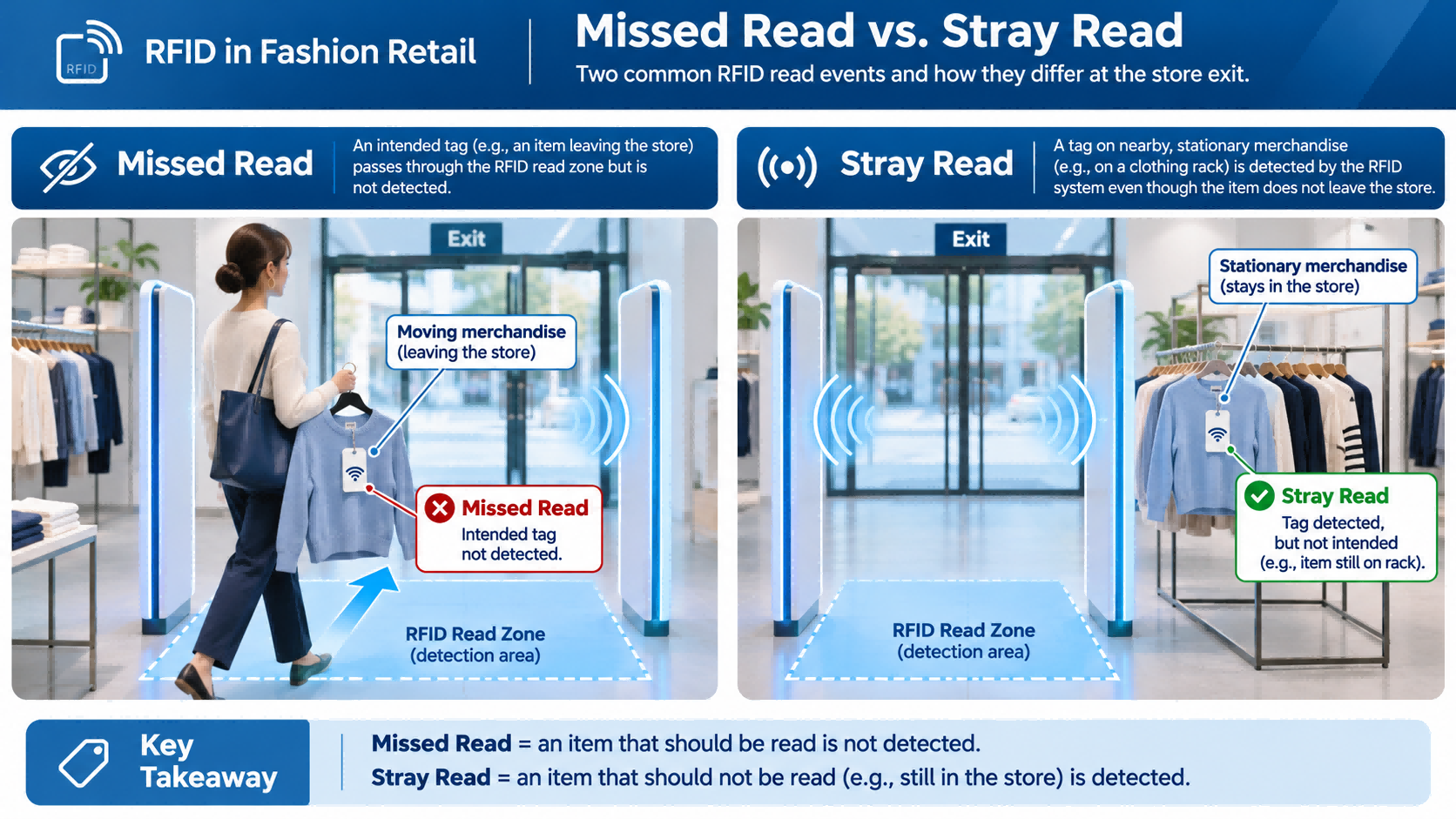
A missed read occurs when a tag that should be detected during an operation is not read.
In fashion retail, a garment tag may be harder to detect when it is held against the body, folded into an unfavourable position or surrounded by materials that affect the radio signal. Damaged tags, inconsistent placement and gaps in antenna coverage can also contribute.
The consequence depends on the task. During a handheld stocktake, an employee may investigate and scan again. At an exit, the opportunity to detect a passing garment may be much shorter.
A stray read occurs when the reader detects a tag outside the intended task or passage.
A common example is a garment hanging on a display rack near the store entrance. The reader may detect it while a shopper walks through, even though the garment remains inside.
A stray read is not automatically a false alarm. It becomes a business problem when the system incorrectly includes it in the count, movement or alarm decision.
Successful filtering may allow a system to detect nearby tags without treating them as exiting merchandise.
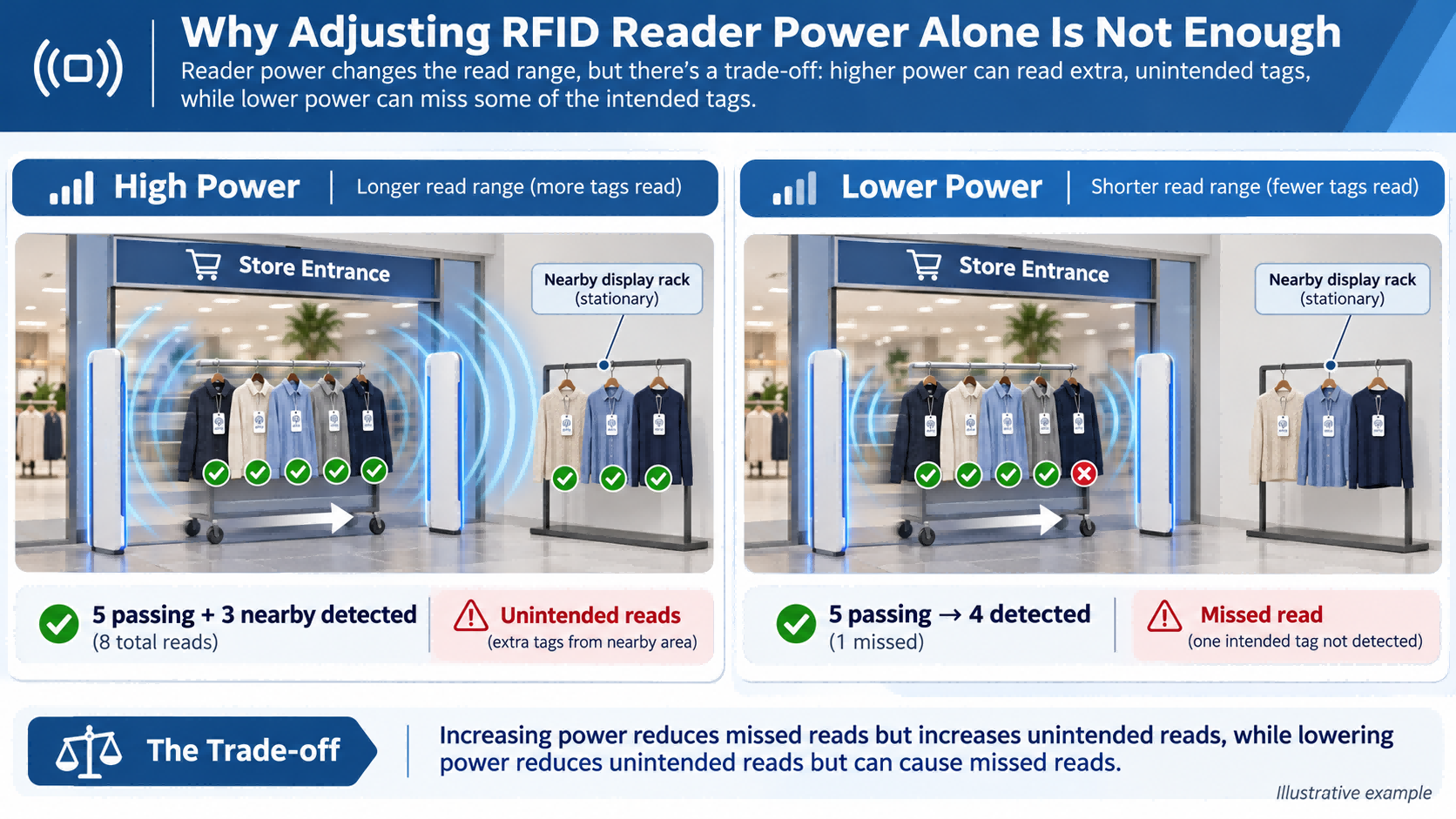
Imagine a shopper carrying five tagged garments through an exit beside a promotional rack.
In this illustrative example, a higher power setting detects all five passing garments plus three stationary garments on the rack.
Five passing garments + three nearby garments = eight detected tags.
The system must determine which five belong to the passage.
Now suppose the power is reduced. The nearby rack is no longer detected, but one garment held close to the shopper’s body is also missed.
Five passing garments → four detected tags.
Power adjustment changes the reading conditions, but it does not independently solve the whole problem. Tag placement, antenna coverage, entrance geometry and event processing also matter.
Software can filter irrelevant detections. It cannot recover the identity of a tag that was never read.
A dependable configuration therefore needs both adequate physical detection and correct interpretation of the resulting data.
Fashion environments combine changing merchandise arrangements with unpredictable customer behaviour.
Garments may hang freely on racks, sit folded on tables or travel together inside shopping bags. Tags change orientation as customers handle products. Nearby metal fixtures and the human body can alter reading conditions.
Store layouts also change. A promotional rack may move closer to the exit after installation, or a new collection may use a different label placement.
The business rules add another layer. A detected garment may be sold, reserved, returned or awaiting processing. Its presence alone does not establish whether it should trigger an alert.
These variations explain why a successful demonstration using one freely held tag is only a starting point.
Scene-based selection begins with the task, rather than a promise that one device will deliver the same result everywhere.
GS1’s apparel guidance places RFID within broader identification and data-quality practices across the supply chain. Consistent product identification supports useful inventory records, while individual workflows require appropriate implementation.
| Apparel workflow | Main objective | What the evaluation should establish |
| Store or warehouse stocktaking | Compare physical garments with expected inventory | Coverage, correct item association, duplicate handling and discrepancy review |
| Receiving or shipping verification | Check goods against the expected transaction | Correct variants and quantities, exclusion of adjacent stock and controlled confirmation |
| Store exit monitoring | Identify relevant departures and apply authorisation rules | Passing-item detection, passage direction, unauthorised-exit alerts and false alarms |
Stocktaking Allows Investigation
A handheld count can include additional passes and review of unread or unexpected items. The evaluation should measure the complete task, including reconciliation, rather than reading speed alone.
Shipping Requires Transaction Matching
Reading a group of tags is useful only when the software can compare them with the intended shipment.
Tracking level also matters. A carton tag identifies the carton; it does not independently verify every untagged garment inside. Individual garment verification requires identification at the appropriate level.
Exit Monitoring Requires Timely Decisions
An exit system must distinguish actual departures from nearby merchandise while applying the relevant authorisation rules.
A strong stocktaking result therefore does not automatically demonstrate strong loss-prevention performance. The operating conditions and consequences of error are different.
Improvement usually comes from several coordinated changes.
Start with tags and placement. Test the intended labels on actual garments, packaging and carrying arrangements. A tag’s performance in open space may not represent its performance on the product.
Design the reading area. Antenna position, mounting height, power and nearby merchandise should be evaluated together. Define which physical area belongs to the operation.
Control the workflow. Establish when a count or movement starts, which items belong to it and when software may confirm a stock update. Repeated detections should not create duplicate transactions.
Add passage context where needed. In an open store entrance, direction and crossing information can help distinguish a passage from tags that remain readable nearby.
For example, FYJ’s AI-Powered Ceiling-Mounted UHF RFID Access Control System product specifications describe visual tracking of people, entry/exit direction recognition, configurable crossing lines and learning-based functions intended to suppress false alarms involving stationary tags. These specified capabilities illustrate how an AI-assisted ceiling-mounted RFID system can add context to an exit decision.
Their effectiveness in a particular clothing store should be established through testing with its garments, tags, layout and customer movements. The specifications alone do not establish a measured reduction in missed reads or false alarms for that store.

A useful pilot compares system results with an independently known record of what physically happened.
Record the products, tag models, attachment positions, installation geometry and nearby stock.
For exit testing, retain normal display racks and include different carrying positions, walking speeds and directions. Test multiple shoppers, pauses near the doorway and mixed authorised and unauthorised items.
For a fashion store exit, useful measures include:
| Metric | Calculation or definition |
| Passing-item detection rate | Detected tagged-item passages ÷ total tagged-item passages tested |
| Unauthorised-exit detection rate | Correctly alerted unauthorised exit events ÷ total unauthorised exit events tested |
| False alarm rate | Normal passage events with an incorrect alert ÷ total normal passage events tested |
| Response time | Time from a defined passage point to the resulting alert |
Count each repeated passage as a separate test instance. Keep garment-level results separate from passage-level alarms.
Also record nearby tags incorrectly assigned to exit events. This reveals whether stray readings are becoming incorrect business decisions.
For stocktaking, report both the initial result and the final result after investigation. For exit monitoring, define what happens when item-authorisation data is unavailable.
This makes additional work and exception handling visible instead of hiding them behind a single percentage.
Repeat tests across representative merchandise combinations, customer volumes and layout variations. Retain the test quantities and conditions alongside the results.
A short run with no errors provides evidence for that run. Repeated testing helps establish how consistently the workflow performs under the conditions the business expects.
Before accepting an accuracy claim, clarify three points:
1. Scope: What counts as success—a tag read, a correct transaction or an appropriate alarm?
2. Evidence: Under which conditions, and across how many test instances, was the result achieved?
3. Operation: What rechecks, exception procedures and reassessments are needed to maintain performance?
A practical acceptance statement might read:
For the agreed garment categories, RFID labels, entrance layout and passage conditions, evaluate passing-item detection, unauthorised-exit detection, false alarms and response time against the agreed thresholds.
Those thresholds should reflect the business task and pilot findings.
FYJ supports apparel businesses with RFID hardware, software and deployment guidance. Defining the requirements first helps match the configuration to the work employees actually need to perform.
The strongest RFID commitment is a measurable result under clearly defined conditions, supported by a workable process for handling exceptions.
Can RFID achieve 100% accuracy in a clothing store?
An RFID system may achieve a 100% observed result in a specific test. The result should state what was measured, the number of tests and the operating conditions. It does not automatically establish the same performance under every future condition.
Does a stray read always cause a false alarm?
No. A reader may detect a nearby garment while the event-processing logic correctly excludes it from the exit event. A false alarm occurs when the completed alarm decision is incorrect.
Can AI solve RFID missed reads?
AI-assisted analysis can help interpret detected events, but it cannot identify a tag that was never read from RFID data alone. Physical detection still depends on tags, placement, coverage and operating conditions.
Is an RFID stocktaking system suitable for exit security?
Stocktaking performance alone does not establish suitability for exit security. Exit monitoring requires evaluation of passage timing, direction, authorisation and alarm behaviour in addition to tag detection.
Hi! Click one of our members below to chat on
 en


 IPv6 network supported