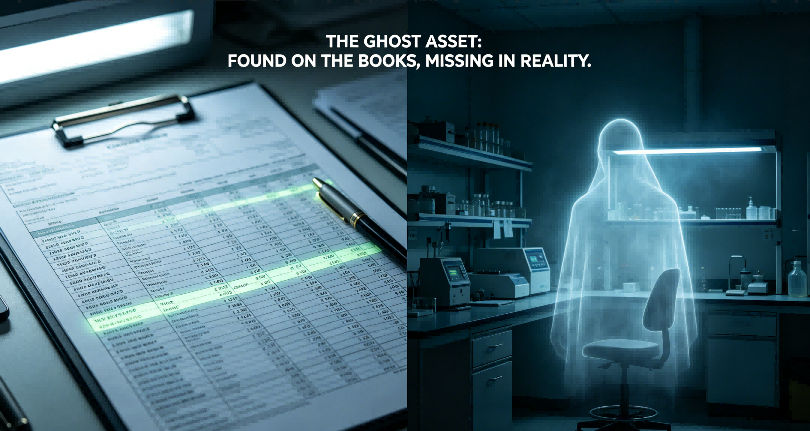
In the highly competitive landscape of global higher education, securing a research grant is a milestone of prestige and progress. However, there is a hidden operational "black hole" that keeps University CFOs and Research Deans awake at night: The Ghost Asset.

Through my years spent in the field—navigating multi-story laboratories, high-density IT server rooms, and sprawling campus storage facilities—I have observed a consistent pattern. Universities are not just centers of learning; they are massive repositories of high-value, grant-funded equipment. When these assets are poorly tracked, they become "Ghosts"—items that exist on the balance sheet but have physically vanished from the campus.
This isn't just an inventory glitch. It is a strategic threat to your institution’s financial lifeblood.
I. The Financial and Legal Stakes of "Ghost Assets"
A "Ghost Asset" represents more than just a missing microscope or a lost server. In a university setting, it creates a triple-threat of liability:
- Grant Compliance and Funding Withdrawal: Most federal and private grants (such as those from the NIH, NSF, or Horizon Europe) come with strict auditing requirements. If an auditor asks to see a $150,000 spectrometer funded by a grant and you cannot locate it within 24 hours, the entire grant—and future funding—could be placed in jeopardy.
- Over-Procurement and Budget Waste: When assets are "invisible," departments often re-order equipment they already own. Our data shows that institutions without automated tracking suffer from 15-20% redundant procurement costs.
- Insurance and Tax Inaccuracies: Universities pay insurance premiums and personal property taxes based on recorded assets. If 15% of your recorded assets are "Ghosts," you are effectively paying thousands of dollars in premiums for equipment that no longer exists.
II. Why Traditional Manual Audits are Failing Your Institution
Many universities still rely on manual barcode scanning. In a modern campus, this is an obsolete strategy.
- The Line-of-Sight Problem: Barcodes require a direct scan. In a lab packed with chemical-resistant containers or under-desk IT equipment, finding every barcode is a physical nightmare.
- The Mobility Gap: University assets are inherently mobile. Laptops, mobile lab carts, and projectors move between departments constantly. Manual systems cannot capture these "ad-hoc" movements, leading to data silos and inaccurate records.
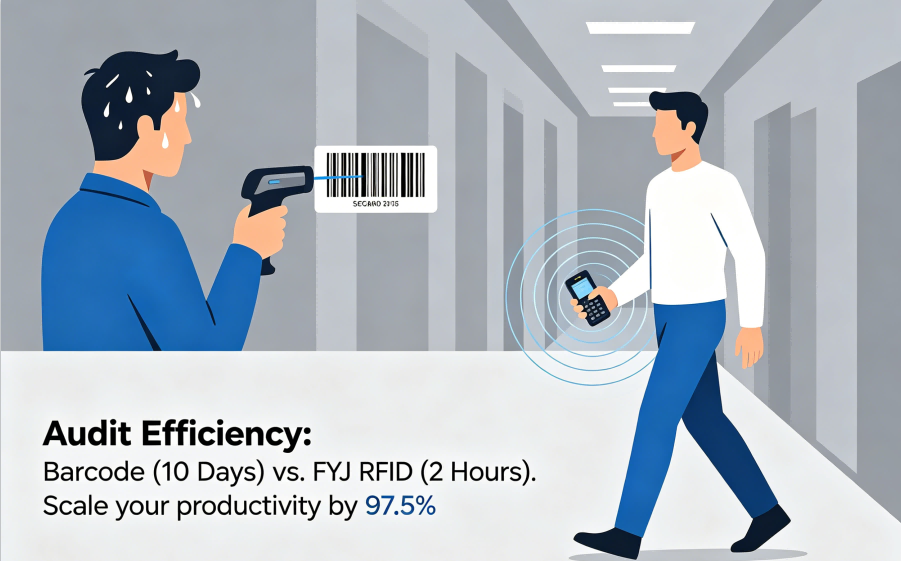
- The Auditor’s Clock: A manual campus-wide audit can take 3 to 6 months. By the time the audit is finished, the data is already outdated.
III. Exorcising the Ghost: The RFID & SaaS Synergy
This is where the transition to RFID (Radio Frequency Identification) becomes a strategic necessity. At FYJ, we advocate for a shift from "counting assets" to "asset intelligence."
- 1. Massive Scale Auditing in Real-Time With RFID, line-of-sight is no longer required. Using an FYJ industrial-grade handheld scanner, a staff member can walk down a laboratory hallway and detect hundreds of tagged items through walls, cabinets, and crates. A process that once took a week can now be completed in 90 minutes, providing a real-time "Snapshot of Truth."
- 2. Gateways and Choke-Point Tracking By installing RFID gateways at the exits of research buildings or IT centers, the university can automatically log the movement of high-value items. If an expensive research instrument leaves its designated zone without authorization, the integrated SaaS platform triggers an immediate alert.
- 3. The "Single Source of Truth" via Organic Integration The true power lies in Organic Integration. Unlike vendors who mix-and-match third-party software with generic hardware, FYJ develops the entire ecosystem. As a National High-Tech Enterprise, we ensure that the communication between our RFID tags and the SaaS cloud is seamless and lag-free. This unified data flow is essential for generating audit-ready reports that satisfy the most stringent grant requirements.
IV. Trust, Security, and Long-Term Stability
For an institution that has stood for decades, or even centuries, a technology partner must offer more than just a product; they must offer stability.
- Security You Can Defend: University data is a target. Our SaaS platform is ISO 27001 (Information Security) and ISO 20000 (IT Service) certified. We ensure that your asset locations and procurement data are protected by bank-level encryption.
- A Partner of Integrity: Backed by a Class 3A Credit Rating and recognized as a China 3.15 Integrity Brand, FYJ provides the financial and ethical reliability required for high-level institutional partnerships. We don't just sell software; we provide a long-term roadmap for campus-wide digital transformation.
Conclusion: Focusing on Science, Not Spreadsheets
The goal of a modern university is to push the boundaries of knowledge. Faculty and researchers should be focused on their next discovery, not on searching for missing equipment. By eliminating "Ghost Assets" through an integrated RFID and SaaS solution, universities can protect their grants, optimize their budgets, and ensure that every resource is precisely where it belongs.
Authoritative Outbound Links
Information Security Standards: ISO/IEC 27001 Official Documentation
Higher Ed Technology Trends: EDUCAUSE - Integrated IT Management
FAQ: Strategic Asset Management for Universities
Q1: How does "Ghost Asset" elimination directly affect our annual budget?
A: Beyond stopping funding clawbacks, eliminating Ghost Assets reduces insurance premiums and prevents "panic buying" of equipment you already own but cannot find. On average, our university clients see a 15% reduction in annual equipment expenditure within the first year.
Q2: Is RFID technology safe for sensitive laboratory equipment (e.g., MRI or high-frequency electronics)?
A: Yes. Passive RFID tags (like those used by FYJ) do not emit continuous signals. They are only "awakened" by the scanner's pulse. This makes them safe for use in most sensitive scientific and IT environments without interfering with equipment performance.
Q3: Can we use the SaaS platform for assets funded by different grants separately?
A: Absolutely. Our SaaS system features Multi-Grant Tagging, allowing you to filter assets by grant ID, funding source, or expiration date. This makes it incredibly simple to generate specific reports for different auditors.
Q4: How does FYJ’s "Organic Integration" help with long-term IT maintenance?
A: Because we are a National High-Tech Enterprise controlling both the hardware and software layers, we provide a single point of support. You won't be caught between a software vendor and a hardware manufacturer; we take full responsibility for the entire system's uptime



 en
en 


 IPv6 network supported