How RFID Linen Tracking Reduces Hotel Linen Loss by Up to 90%?
Jun 25, 2026
For many hotels, linen loss is a hidden operational cost that quietly grows year after year.Missing towels, misplaced bed sheets, unreturned bathrobes, and inventory discrepancies between hotels and laundry providers often result in significant replacement expenses. While these losses may seem small on a daily basis, they can easily accumulate into tens or even hundreds of thousands of dollars annually for large hotel groups.Over the past few years, we have seen a growing number of hotels, healthcare facilities, and commercial laundry operators adopt RFID linen tracking systems to gain full visibility into their linen operations.
The reason is simple: you cannot manage what you cannot track.
Why Linen Loss Remains a Major Challenge
In traditional hotel linen management, tracking is often based on manual counting, spreadsheets, or barcode systems.From our experience working on RFID inventory management projects, these methods create several challenges:
Manual counting consumes significant labor hours
Inventory records are frequently inaccurate
Lost linens are difficult to identify
Laundry service disputes become common
Management lacks real-time visibility
Many hotels know their linen replacement costs are increasing, but they cannot clearly determine where losses are occurring.Without accurate data, operational decisions become reactive rather than proactive.
The Growing Demand for RFID Linen Tracking
As hotels continue investing in digital transformation and operational efficiency, RFID linen tracking has become one of the most widely adopted technologies in the hospitality industry.Unlike barcode systems, RFID technology allows multiple tagged linen items to be identified simultaneously without direct line-of-sight scanning.Each towel, sheet, pillowcase, or bathrobe can be assigned a unique RFID linen tag that remains attached throughout its service life.This creates complete traceability from purchase to retirement.
How an RFID Linen Tracking System Works
A typical RFID linen management solution consists of:
RFID Linen Tags
RFID Readers
RFID Handheld PDA Devices
RFID Portal Gates
RFID Linen Management Software
Inventory and Reporting Dashboards
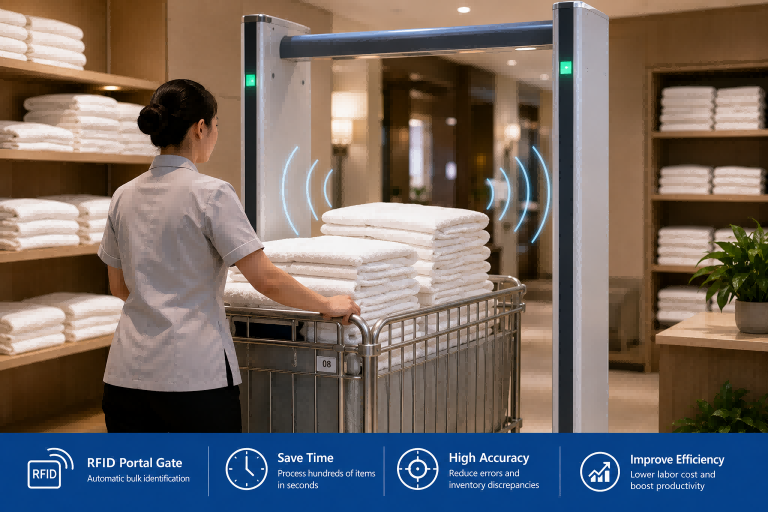
When linens move through operational checkpoints, RFID readers automatically capture item information and update the database in real time.Instead of counting hundreds of linens manually, staff can process entire carts within seconds.
Where Hotels Typically Lose Linens
Based on industry experience, linen loss usually occurs in five key areas.
1. Guest Rooms
Towels, robes, and specialty linens may leave the property unintentionally or intentionally.
Without item-level tracking, identifying loss patterns becomes nearly impossible.
2. Laundry Processing
Hotels frequently outsource laundry services.
When thousands of items move between facilities daily, discrepancies can occur during collection, washing, transportation, or delivery.
3. Storage Areas
Inventory records often become inaccurate when staff manually issue or return linens.
4. Interdepartmental Transfers
Linens transferred between housekeeping, spa facilities, restaurants, and banquet operations can become difficult to track.
5. End-of-Life Disposal
Many organizations replace linens without knowing whether items have reached their expected service life.
This leads to unnecessary purchasing costs.
FYJ Field Experience: The Real Problem Is Usually Visibility, Not Inventory
In many RFID linen management projects, we initially hear the same concern from hotel operators:"We keep purchasing new linens, but we still don't know where they are going."However, after conducting on-site assessments, the root cause is often not a shortage of linens—it is a lack of visibility throughout the linen lifecycle.
At FYJ, we have observed that linen discrepancies typically occur at transition points:
Between hotel departments
During laundry collection and delivery
During temporary storage
During manual counting processes
Without reliable tracking data, management teams are forced to rely on estimates rather than facts.This is why many organizations choose to implement RFID linen tracking not only to reduce losses, but also to gain real-time operational visibility and accountability across the entire process.
How RFID Reduces Linen Loss by Up to 90%
Real-Time Inventory Visibility
Every movement is recorded automatically.Managers gain immediate visibility into:
Current inventory levels
Laundry status
Linen locations
Missing items
Usage history
This eliminates the guesswork commonly associated with linen management.
Automated Bulk Counting
One of the most significant improvements comes from inventory counting.
Using RFID readers or RFID PDA devices, staff can count hundreds of linens in seconds.
What previously required hours can now be completed within minutes.
Laundry Accountability
RFID creates a digital record every time linens enter or leave a laundry facility.
Hotels and laundry providers can verify quantities automatically, reducing disputes and improving operational transparency.
Loss Pattern Analysis
When data is consistently collected, management can identify recurring loss patterns.
For example:
Specific departments with higher loss rates
Particular linen categories frequently missing
Operational processes contributing to shrinkage
This enables targeted corrective action.
Lifecycle Management
RFID linen tags allow organizations to track wash cycles and usage history.
Hotels can determine:
How many times each item has been washed
Which linens are nearing replacement
Actual asset utilization rates
This improves purchasing decisions and extends linen lifespan.
Why an Integrated RFID Solution Matters
One common misconception is that RFID deployment is simply about attaching RFID tags to linens.In reality, successful projects require the coordination of multiple components, including RFID tags, handheld readers, fixed readers, portal gates, and management software.
At FYJ, we focus on providing integrated RFID solutions rather than standalone hardware.By combining RFID readers, RFID PDA devices, RFID portal gates, and software platforms into a unified system, hotels and laundry operators can achieve real-time visibility throughout receiving, washing, storage, distribution, and inventory management processes.This integrated approach helps organizations maximize the value of RFID data while minimizing operational complexity.
Benefits Beyond Loss Prevention
Although loss reduction is often the primary goal, RFID linen tracking provides additional operational benefits.
Improved Inventory Accuracy
Automated identification reduces human error and increases inventory reliability.
Lower Labor Costs
Staff spend less time counting and searching for missing items.
Faster Audits
Inventory audits can be completed significantly faster.
Better Guest Experience
Adequate linen availability improves housekeeping efficiency and guest satisfaction.
Data-Driven Decision Making
Managers gain access to operational insights that support budgeting, forecasting, and procurement planning.
RFID Linen Tracking for Hospitals and Healthcare Facilities
The same technology is increasingly being adopted by hospitals and healthcare organizations.In healthcare environments, linen traceability is critical for:
Infection control
Asset accountability
Regulatory compliance
Inventory optimization
RFID hospital linen tracking systems provide complete visibility across the linen lifecycle while reducing manual workload.
Choosing the Right RFID Linen Management Solution
Successful RFID deployment requires more than simply attaching tags.Organizations should evaluate:
RFID tag durability
Wash cycle resistance
Reader performance
Software scalability
Integration capabilities
Reporting functionality
The most effective solutions combine reliable RFID hardware with intuitive management software that delivers actionable operational data.
Final Thoughts
Linen loss is not simply an inventory problem—it is an operational visibility problem.Hotels that continue relying on manual processes often struggle to understand where losses occur, how inventory moves, and when replacement purchases are actually necessary.RFID linen tracking changes this by providing accurate, real-time visibility across the entire linen lifecycle.From inventory counting and laundry accountability to lifecycle management and loss prevention, RFID technology enables hotels to reduce costs, improve efficiency, and make smarter operational decisions.As hospitality organizations continue investing in digital transformation, RFID linen tracking is rapidly becoming a standard component of modern hotel linen management.
About FYJ
FYJ specializes in RFID hardware and software solutions for inventory management, asset tracking, warehouse automation, and linen management applications.
Our portfolio includes:
RFID Readers
RFID PDA Devices
RFID Portal Gates
RFID Printers
RFID Tags
Warehouse Management Software
Fixed Asset Management Software
Based on practical deployment experience across logistics, hospitality, healthcare, manufacturing, and commercial laundry environments, we help organizations transform manual tracking processes into real-time visibility systems.As RFID adoption continues to accelerate, our goal remains simple: deliver reliable solutions that solve operational challenges in the real world—not just in theory.
Frequently Asked Questions
1. What is RFID linen tracking?
RFID linen tracking uses RFID tags and readers to automatically identify, track, and manage linens throughout their lifecycle.
2. How long do RFID linen tags last?
Most industrial RFID linen tags can withstand hundreds of commercial wash cycles and remain functional for several years.
3.Can RFID reduce hotel linen loss?
Yes. Many hotels report significant reductions in linen loss after implementing RFID linen management systems because inventory movements become fully traceable.
4.Is RFID better than barcodes for linen management?
For high-volume linen operations, RFID offers faster counting, bulk identification, and improved inventory visibility compared to barcode systems.
5.Can RFID track linen wash cycles?
Yes. RFID systems can record usage history and wash counts, helping organizations manage linen lifecycles more effectively.
Further Reading
RAIN RFID Alliance: https://rainrfid.org
GS1 Global Standards: https://www.gs1.org
RFID Journal: https://www.rfidjournal.com
FYJ RFID Solutions: https://www.fyjadic.com
Read More


 en
en 


 IPv6 network supported