RFID for Fashion Retail: How Clothing Stores Can Improve Inventory, Checkout, Product Finding and Loss Prevention
Sep 18, 2026
Fashion retail moves fast.
SKUs keep increasing, product styles change quickly, and customers expect stores to know exactly what is available, where it is, and how quickly it can be purchased.
For many clothing retailers, however, daily operations still depend heavily on manual counting, barcode scanning, spreadsheets, and staff experience.
That creates a familiar set of problems:
Inventory records do not match physical stock
Stocktaking takes too long
Checkout slows down during peak periods
Products go missing without a clear trace
Staff spend too much time searching for sizes or styles
Store and warehouse data are not always synchronized
RFID offers a different way to manage these workflows.
By assigning each item a unique RFID identity and combining tags with handheld readers, RFID checkout devices, access control equipment, and retail management software, stores can manage inventory and item movement more efficiently across the full retail process.
Quick Answer
An RFID retail system can help fashion stores improve five areas:
Inventory counting — batch-read many tagged items instead of scanning one by one
Checkout — read multiple products at once
Product finding — use handheld RFID signal strength to locate a specific item
Loss prevention — monitor tagged items at store exits
Traceability — keep item movement and sales records connected in one system
For fashion retailers with many SKUs, multiple stores, or frequent inventory movement, these improvements can significantly reduce manual work and improve stock visibility.
Why Fashion Retail Stores Struggle with Inventory Management
Fashion retail is more difficult to manage than it may look from the customer side.
A store may carry hundreds or thousands of combinations across:
style
color
size
season
brand
location
Once inventory is distributed across stores, backrooms, warehouses, and online channels, small recording errors quickly become larger operational problems.
1. Inventory Data Becomes Inaccurate
Many retailers still rely on manual entry or disconnected systems.
When product codes, warehouse rules, or store processes are inconsistent, headquarters may not have a reliable real-time view of inventory.
Typical problems include:
missed inbound records
missed transfer records
incorrect stock adjustments
delayed data updates
differences between system stock and physical stock
The result is simple:
The system says an item exists, but staff cannot find it.
Or the store appears out of stock even when the item is physically available.
2. Stocktaking Takes Too Long
Traditional fashion store inventory counting is labor-intensive.
When every item must be checked manually or scanned individually, a monthly or quarterly stocktake can take hours or even days.
For stores with a large number of SKUs, this creates several problems:
stores may need to pause normal operations
employees are pulled away from customer service
counting errors accumulate
results become outdated quickly
The more frequently inventory changes, the harder it becomes to rely on slow counting methods.
3. Checkout Becomes a Bottleneck
Barcode checkout works well when the number of items is small.
But during busy periods, scanning products one by one creates queues.
If a customer buys several garments, each item needs to be positioned and scanned individually.
This adds time at the checkout counter and increases staff workload.
For high-traffic fashion stores, checkout speed can directly affect the customer experience.
4. Losses Are Difficult to Trace
Retail loss does not always come from one clear source.
A product may:
leave the store without being properly recorded
be transferred incorrectly
be misplaced
be entered incorrectly
disappear during daily operations
When the store lacks item-level movement records, it becomes difficult to identify where the difference occurred.
This is especially challenging for higher-value apparel, shoes, bags, accessories, and visually similar products.
5. Finding the Right Item Takes Too Long
A common retail scenario is simple:
A customer likes a product but needs another size or color.
The system may show that the item is in stock, but the employee still has to find it.
In a crowded stockroom, that can take several minutes.
The longer the customer waits, the greater the chance that the sale is lost.
How an RFID Retail Solution Changes Store Operations
FYJ’s RFID retail approach combines software and RFID hardware to give each tagged item a unique digital identity and connect that identity to daily retail workflows.
A typical setup may include:
RFID tags
RFID handheld PDA
RFID printer
RFID checkout equipment
RFID access control
retail or inventory management software
The goal is not simply to “add RFID”.
The goal is to make item movement easier to identify, record, and manage.
1. Faster Inventory Counting with RFID Handhelds
One of the most immediate improvements is stocktaking.
With an RFID handheld PDA such as the FYJ F9850, employees do not need to scan every barcode individually.
They can move along racks or shelves while the handheld reads multiple RFID tags in batches.
In practice, this changes the workflow from:
Find Item → Aim Scanner → Scan One by One
to:
Walk Through Area → Read Multiple Tags → Upload Results
Inventory data can then be compared with system records and used to generate inventory reports.
In FYJ retail projects, this approach has helped reduce counting time from days to hours and improve stock accuracy.
2. Faster Checkout with RFID
RFID can also change the checkout process.
Instead of scanning every item separately, multiple RFID-tagged products can be identified together.
With an RFID self-checkout or RFID checkout device, customers or staff can place several products into the reading area.
The system reads the tagged items and generates the order total.
This is particularly useful when customers purchase multiple garments at once.
The value is not only faster payment.
It also reduces repetitive scanning work at the checkout counter.
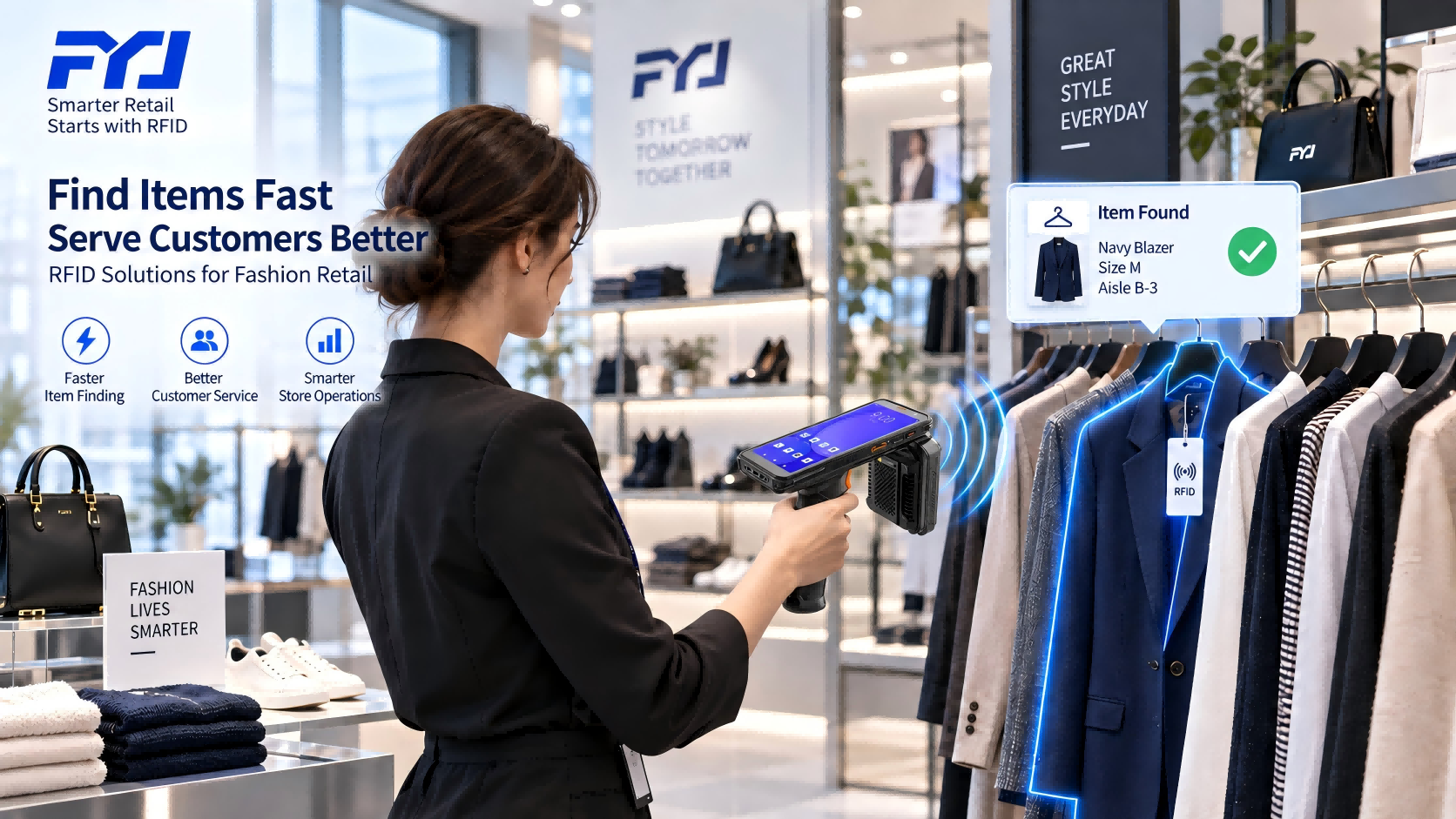
3. Faster Product Finding with RFID Handhelds
RFID handheld devices can also help employees find a specific item.
If a product is recorded in the system but difficult to locate, staff can search for the item and use RFID signal strength as a guide.
As the employee moves closer to the tagged item, the signal becomes stronger.
This is useful for:
finding a specific size
finding a particular color
locating a misplaced item
searching stockrooms
checking backroom inventory
In stores where employees frequently move between the sales floor and stockroom, this can reduce customer waiting time.
4. RFID Loss Prevention at Store Exits
RFID access control can help stores monitor tagged items moving through entrances and exits.
When the gate is integrated with the retail management system, the system can use tag status to help distinguish normal and unauthorized product movement.
For example:
purchased product → normal passage
restricted or unpaid product → alarm event
This adds another layer of control to store operations.
For retailers, the value is not only the alarm itself.
The more important part is that item movement can become part of a traceable digital record.
5. Full Item Traceability
RFID works best when it is connected to software.
From receiving to sale, item activity can be recorded throughout the process.
A typical product record may include:
receiving
warehouse entry
transfer
store arrival
inventory count
checkout
outbound record
final sale
This gives management a clearer view of what happened to each product and where differences may have occurred.
For multi-store retailers, that can also improve coordination between headquarters, stores, and warehouses.
Real RFID Retail Project Examples
The strongest value of RFID becomes easier to understand when looking at real store environments.
Case 1: Apparel Retail Store in Dongguan
Challenge
The store carried a large number of SKUs.
Traditional manual stocktaking required several days, while inventory data lagged behind actual store conditions.
The retailer also faced frequent stock discrepancies and pricing confusion.
FYJ Solution
The store implemented an FYJ RFID retail management solution to improve inventory control and daily store operations.
Result
Inventory counting time was reduced from several days to several hours.
Inventory accuracy and physical-to-system consistency improved to 99%.
Case 2: Cross-Border Fashion Retail Operation
Background
A fashion retail company operated a warehouse in China together with stores and supporting warehouse operations in Thailand.
The company needed to improve overseas store inventory counting, checkout speed, and inventory synchronization.
FYJ Solution
FYJ deployed an RFID retail management solution across the relevant inventory and store workflows.
Result
Inventory counting efficiency improved by 80%
Checkout time was reduced by 50%
Inventory data between domestic and overseas locations could be synchronized in real time
For this type of business, RFID supported not only individual store efficiency but also better visibility across locations.
Case 3: Department Store Retailer in Xinjiang
Challenge
The customer managed a large variety of department store products.
The number of SKUs was high, products were visually similar, and manual counting was difficult and error-prone.
The value of some products also increased the importance of stock accuracy and loss prevention.
FYJ Solution
The customer implemented an FYJ RFID retail management solution.
Result
Stocktaking efficiency improved by more than 10×
Inventory accuracy reached 99%
Loss reduction improved by 9%–30%
Replenishment decisions became more accurate
Which Fashion Retailers Benefit Most from RFID?
RFID is especially useful when a store has one or more of these characteristics:
Retail Situation
Why RFID Helps
Large number of SKUs
Faster batch inventory counting
Frequent stock movement
Better item-level visibility
Multiple stores
Easier inventory synchronization
High checkout volume
Faster multi-item identification
Difficult stockroom search
Faster item finding
Higher-value products
Better movement records and loss control
Frequent stock discrepancies
Better reconciliation between physical and system inventory
A very small store with limited inventory may not need a full RFID system.
The value becomes clearer as inventory volume, store count, and operational complexity increase.
Barcode or RFID for Fashion Retail?
Barcode is still useful in many retail environments.
The difference is mainly how items are identified.
Barcode
requires line-of-sight
usually reads one item at a time
low implementation cost
suitable for simple checkout and inventory workflows
RFID
does not require direct line-of-sight
supports batch identification
supports faster stocktaking
can assist with product locating
can support automated entry/exit monitoring
For many retailers, the decision is not necessarily “barcode or RFID only.”
A hybrid setup is also possible.
Barcode may continue to be used for selected workflows while RFID is introduced where batch reading or movement tracking provides more value.
What Should Retailers Check Before Deploying RFID?
Before choosing hardware, it is important to understand the store workflow.
Ask:
How many SKUs does each store manage?
How long does a full stocktake take today?
How often do stock discrepancies occur?
Does the retailer operate multiple stores?
Is inventory shared with an online channel?
Is faster checkout important?
Do employees frequently search for missing products?
Is loss prevention a major concern?
Does the existing POS or retail system need integration?
These questions usually matter more than choosing the reader with the longest reading distance.
FYJ RFID Retail Solution
FYJ provides integrated RFID software and hardware for retail inventory and store management.
Depending on the application, a project may combine:
RFID tags
RFID handheld PDA
RFID printer
RFID checkout devices
RFID access control
retail management software
inventory management functions
The solution can support workflows from receiving and inventory counting to checkout, product finding, movement monitoring, and reporting.
The exact configuration should be based on the store’s actual operation rather than using the same hardware combination for every project.
FAQ
What is RFID in fashion retail?
RFID in fashion retail uses RFID tags and readers to identify products without scanning each barcode individually. It can support inventory counting, checkout, product finding, movement tracking, and loss prevention.
How does RFID improve stocktaking?
RFID handheld readers can identify multiple tagged items in batches, allowing staff to count inventory much faster than scanning products one by one.
Can RFID help employees find a missing product?
Yes. An RFID handheld can use signal strength to help guide employees toward a specific tagged item.
Can RFID improve checkout speed?
Yes. RFID checkout devices can identify several tagged products at the same time instead of requiring individual barcode scans.
Can RFID work across multiple stores?
Yes. When connected to a centralized retail or inventory management platform, RFID data can support inventory visibility across different locations.
Does RFID replace barcode completely?
Not necessarily. Many retailers can use RFID and barcode together depending on the workflow.
Conclusion
RFID can improve fashion retail operations in ways that go beyond faster inventory counting.
When tags, handheld devices, checkout equipment, access control, and software work together, retailers can gain better visibility into how products move through stores and warehouses.
For fashion retailers managing many SKUs, multiple locations, frequent stock movement, or recurring inventory discrepancies, RFID can help make inventory more accurate, checkout faster, product finding easier, and store operations more traceable.
The key is not simply adding RFID hardware.
It is designing the RFID workflow around how the store actually operates.
Read More


 en
en 


 IPv6 network supported