Unlocking Supply Chain Efficiency: How Sound & Light IoT Tags Stop Returnable Asset (RTI) Loss and Revolutionize Pallet Tracking?
Jun 11, 2026
In global supply chains, returnable transport items (RTIs)—such as pallets, plastic crates, totes, and roll cages—are the unsung heroes of material handling. They keep products moving safely, efficiently, and sustainably. Yet, for logistics managers and supply chain directors, they also represent a massive, persistent operational leak.
According to the Reusable Packaging Association (RPA), industries suffer an estimated 10% to 15% annual loss rate of returnable assets. Pallets and crates disappear into transit blind spots, get misplaced in massive distribution centers, or are simply never returned by receivers. The replacement costs, coupled with the labor hours wasted on manual warehouse searches, drain profit margins and disrupt the flow of reverse logistics.
Traditional tracking systems like standard barcodes or passive RFID tags help, but they fall short in real-time, high-density environments.
This is where the next generation of smart logistics comes in: Returnable Asset Management systems powered by Bluetooth Low Energy (BLE) Sound & Light (Audible-Visual) Tags. Here is how this breakthrough IoT solution solves the "needle-in-a-haystack" tracking and inventory stocktaking pain points.
The "RTI Black Hole": The Core Pain Points of Returnable Asset Management
Managing a closed-loop pool of reusable transit containers is notoriously difficult. Logistics and warehouse operations face three critical pain points:
1. In-Transit Blind Spots (The Shrinkage Problem)
Once a shipment of pallets or tote boxes leaves your fulfillment center, visibility drops to near-zero. Whether assets are left behind at a customer’s retail site, hoarded by third-party logistics (3PL) partners, or stolen, "shrinkage" is a constant operational drain. Replacing lost wooden or heavy-duty plastic pallets is a major capital expenditure that directly inflates your Total Cost of Ownership (TCO).
2. Chaotic Warehouse Stocktaking & Manual "Needle-in-a-Haystack" Searches
Even inside the warehouse, assets get lost. If a forklift operator places a stack of specific pallets or custom周转箱 (totes) in the wrong high-stack racking aisle, finding them becomes a nightmare. Workers spend hours wandering aisles, scanning barcodes one by one, or climbing racks to identify a specific container. This manual lookup is a massive waste of labor and stalls order fulfillment.
3. The Reverse Logistics Breakdown
A closed-loop supply chain only works if the "closed" part is executed efficiently. When manufacturers do not have clear data on which distributor has their empty pallets and crates—or how long they have been holding them—the circular logistics flow breaks down. The result? A mismatch between product flow and RTI availability, leading to emergency pallet rentals or delayed shipments.
The Breakthrough: BLE Sound & Light Tags as the Ultimate Solution
Active IoT technologies like Bluetooth Low Energy (BLE) are transforming asset management. By adding Audible & Visual (Sound & Light) indicators directly to ruggedized BLE tags, enterprises can bridge the gap between digital data and physical action.
What are Sound & Light IoT Tags?
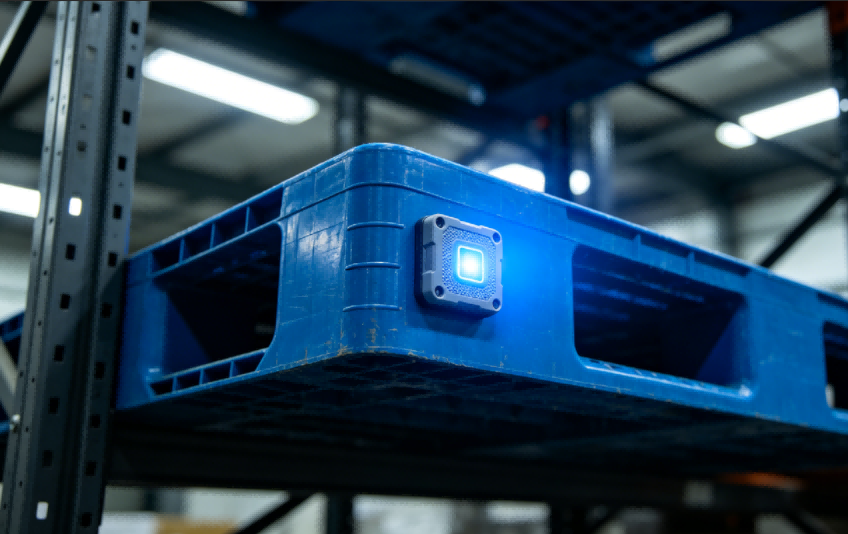
These are industrial-grade BLE beacons or active RFID tags designed to withstand harsh warehouse environments (typically IP67 or IP68 waterproof and shockproof). Along with a long-life battery (often lasting 3 to 5 years), they feature:
High-Intensity LED Lights: Ultra-bright LEDs that flash on command.
Built-in Acoustic Buzzers: Piezoelectric buzzers capable of emitting a clear, high-decibel beep (up to 85dB-90dB) even in noisy industrial warehouses.
How the Sound & Light Tracking System Works:
Tag-to-Asset Binding: Every plastic pallet or tote box is fitted with a rugged BLE Sound & Light tag. The tag's unique ID is digitally mapped to a GS1 Global Returnable Asset Identifier (GRAI) standard in your Warehouse Management System (WMS) or ERP.
In-Transit Gateway Tracking: While in transit, BLE-enabled GPS trackers, telematics on trucks, or mobile driver apps detect the tags, updating their location in real-time.
One-Click "Find-My-Pallet" Visual/Audible Guidance: When a warehouse worker needs to locate a specific pallet, stack of totes, or high-value transit box, they simply search the ID in their handheld PDA, mobile app, or WMS dashboard.
Instant Physical Feedback: With one click on the system, the target tag’s LED flashes bright blue/green and the buzzer sounds. The worker bypasses hours of search and walks straight to the flashing, beeping asset.
4 Ways Sound & Light Tags Drive Immediate ROI
1. Slash Searching and Stocktaking Time by up to 90%
Conducting inventory in a 100,000-square-foot warehouse can take days. With BLE Sound & Light tags, inventory checks can be fully automated using overhead BLE gateways. Furthermore, localized "picking" or sorting of pallets is sped up exponentially. Instead of scanning 50 barcodes to find the right pallet, the worker triggers the flash and beep, locating the asset in under 5 seconds.
2. Minimize Asset Loss and Shrinkage
Real-time visibility means accountability. When distributors or 3PLs know that you have real-time tracking on your returnable plastic crates and can pinpoint exactly which site has been holding them for more than 14 days, the return rate increases dramatically. If an asset leaves a geofenced area unauthorized, the system immediately triggers an alert.
3. Streamlined Reverse Logistics and Faster RTI Cycle Times
Optimize your pallet pool size by accelerating cycle times. When you know precisely where empty crates are and when they are ready to be picked up, you can schedule optimized return routes. Faster rotation means you can support a higher volume of product shipments with fewer physical assets, dramatically reducing upfront capital expenditures.
4. Zero Line-of-Sight Requirements
Unlike standard barcodes or passive RFID tags, BLE signals do not require line-of-sight. If a smart pallet is buried under five other pallets or stacked deep inside a dark racking corner, the BLE signal still propagates, and the acoustic buzzer guides the worker directly to its exact spot.
Real-World Applications: Who Benefits Most?
Cold Chain & Fresh Food Distribution: Insulated plastic crates and food totes are high-value RTIs. Sound & light tags help warehouse workers quickly locate and sort crates in freezing, foggy cold-storage rooms where barcodes are often unreadable due to condensation.
Automotive & High-Value Manufacturing: Automotive parts are transported in custom returnable metal bins and plastic containers. Misplacing a single container can stall an entire assembly line. Sound & light tags ensure parts are tracked with precision from the supplier's warehouse directly to the manufacturing line.
Retail & E-commerce Fulfillment: Large retail fulfillment centers rely on millions of plastic totes. Audible-visual tags speed up batch-picking operations and optimize bin replenishment in multi-level mezzanine racks.
Conclusion: Moving from Passive Tracking to Active Localization
The era of "passive" tracking is no longer sufficient for modern supply chains. Merely knowing that a pallet is "somewhere in Warehouse B" still leaves workers searching.
By upgrading to an IoT Returnable Asset Management solution with Sound & Light BLE Tags, supply chain leaders can eliminate in-transit blind spots, slash warehouse searching time to near-zero, and reclaim millions of dollars lost to pallet and container shrinkage. It is time to turn your quiet, invisible transport items into active, self-reporting smart assets.
External Authority & Standards Resources
For further reading on international packaging standards and reusable asset tracking guidelines, consult these authoritative industry resources:
GS1 US Standards for Returnable Asset Tracking (GRAI): Learn how the Global Returnable Asset Identifier (GRAI) standardizes pallet and container tracking globally.
Reusable Packaging Association (RPA) Technology Resources: Access whitepapers and industry insights on reducing asset loss and optimizing closed-loop supply chains.
GS1 EANCOM Reusable Transport Items Guideline: Technical specifications and operational guidelines for implementing RTI tracking inside existing ERP architectures.
FAQ (Frequently Asked Questions)
Q1: How does a BLE Sound & Light tag differ from standard Passive RFID or Barcodes?
A: Barcodes and passive RFID require direct line-of-sight or very close-range scanning (often within a few meters) and do not provide physical indicators. If a pallet is hidden or high up on a rack, they are incredibly difficult to find. BLE Sound & Light tags are active devices with a range of up to 100+ meters. They do not require line-of-sight, and they actively emit LED flashes and audio beeps to guide workers directly to their physical location.
Q2: What is the battery life of Sound & Light IoT tags on pallets?
A: Depending on the broadcast frequency (ping interval) and how often the LED flash and buzzer are triggered, these industrial BLE tags typically last between 3 to 5 years. Many advanced models feature replaceable batteries or low-power sleep modes when the asset is stationary (detected via a built-in accelerometer).
Q3: How do these tags perform in loud, busy warehouse environments?
A: Industrial buzzers on these tags are designed to emit high-frequency, high-decibel (usually 85dB to 90dB) sounds that cut through standard warehouse ambient noise. When combined with the ultra-bright flashing LED, workers can rely on visual cues if the environment is too loud.
Q4: Can Sound & Light tags integrate with our existing Warehouse Management System (WMS)?
A: Yes. Modern BLE solutions use middleware or open APIs to communicate seamlessly with major WMS, TMS (Transportation Management Systems), and ERP systems (like SAP or Oracle). Triggering the "sound and light" is as simple as clicking a button inside your existing warehouse mobile app.
Read More


 en
en 


 IPv6 network supported