

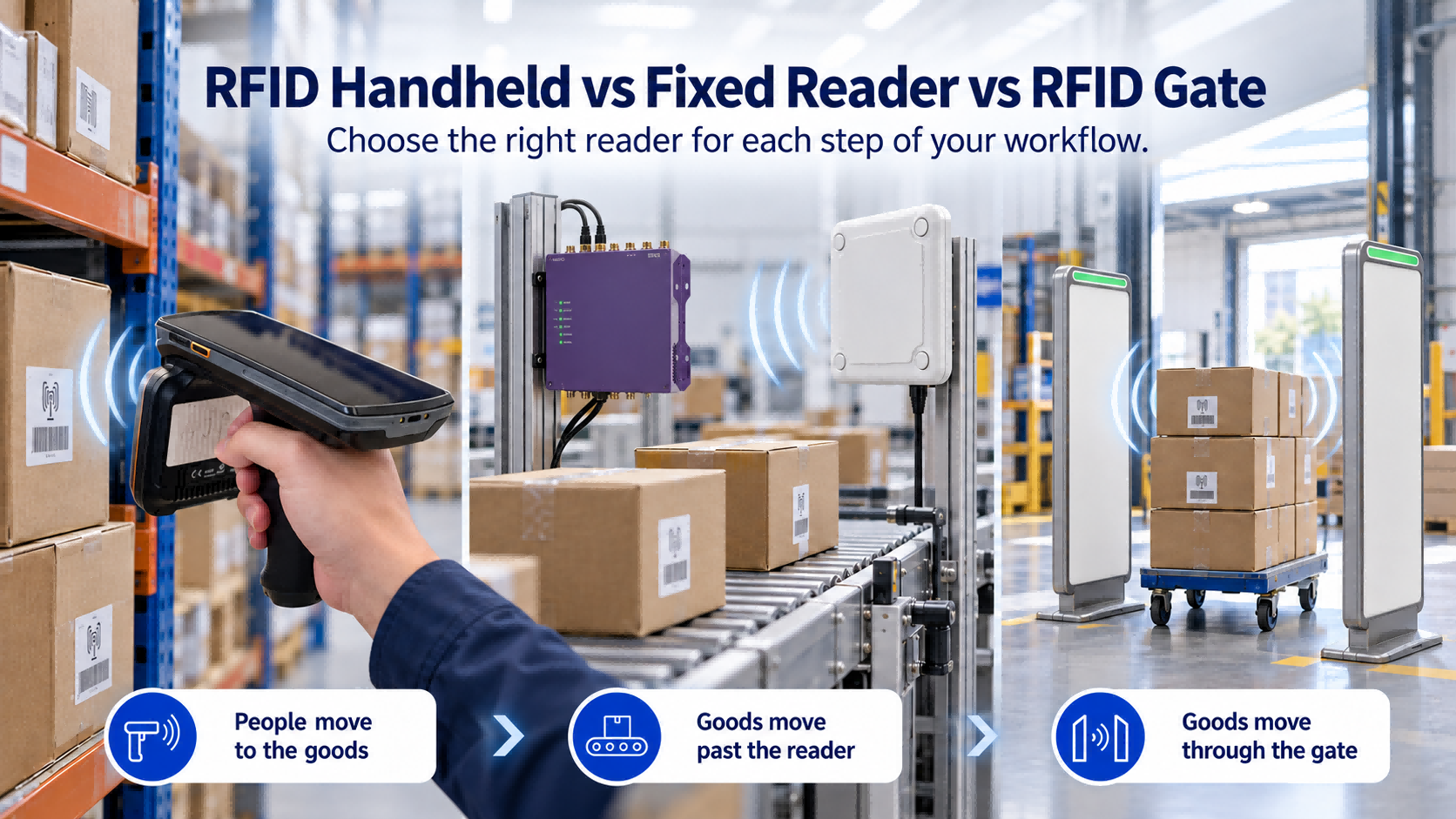
At the 140th Canton Fair, many customers asked us a similar question after discussing RFID tags and software integration:
“Which RFID reader should we use?”
Some customers wanted a handheld device for fast inventory counting.
Others needed fixed RFID readers for automatic identification at specific points.
Large warehouse projects asked about RFID gates for inbound and outbound monitoring.
All three devices can read RFID tags, but they solve different problems.
The easiest way to decide is to look at how goods move through the workflow.
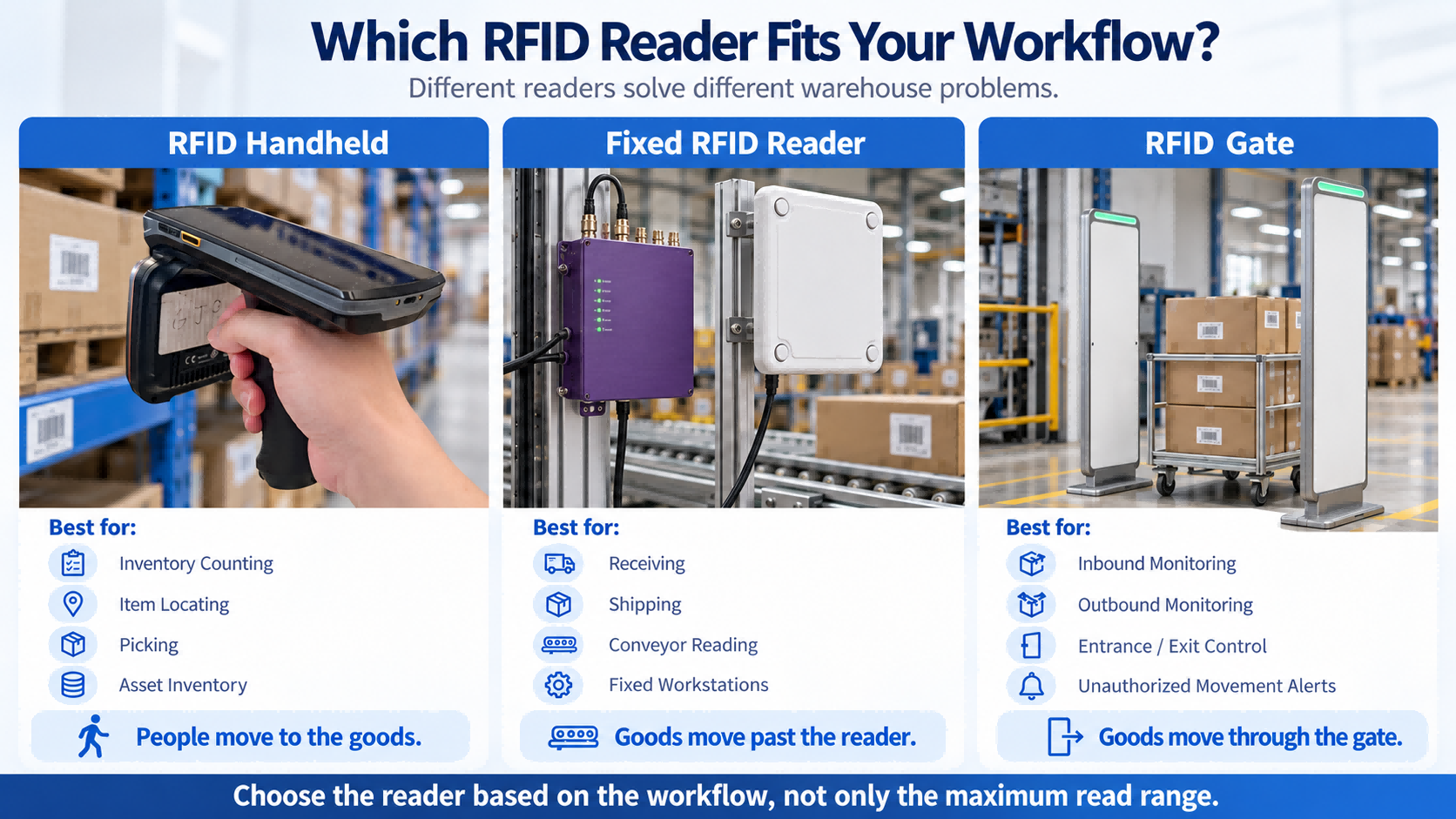
Choose an RFID handheld reader if employees need to move around the warehouse and perform inventory, locating, receiving, picking or shipping checks.
Choose a fixed RFID reader if tagged goods repeatedly pass through a defined reading point and automatic identification is required.
Choose an RFID gate if goods move through a controlled entrance or exit and the system needs to record movement, verify authorization or trigger an alert.
The Simplest Rule
Employee moves to the goods → RFID Handheld
Goods move past a fixed point → Fixed RFID Reader
Goods move through an entrance or exit → RFID Gate
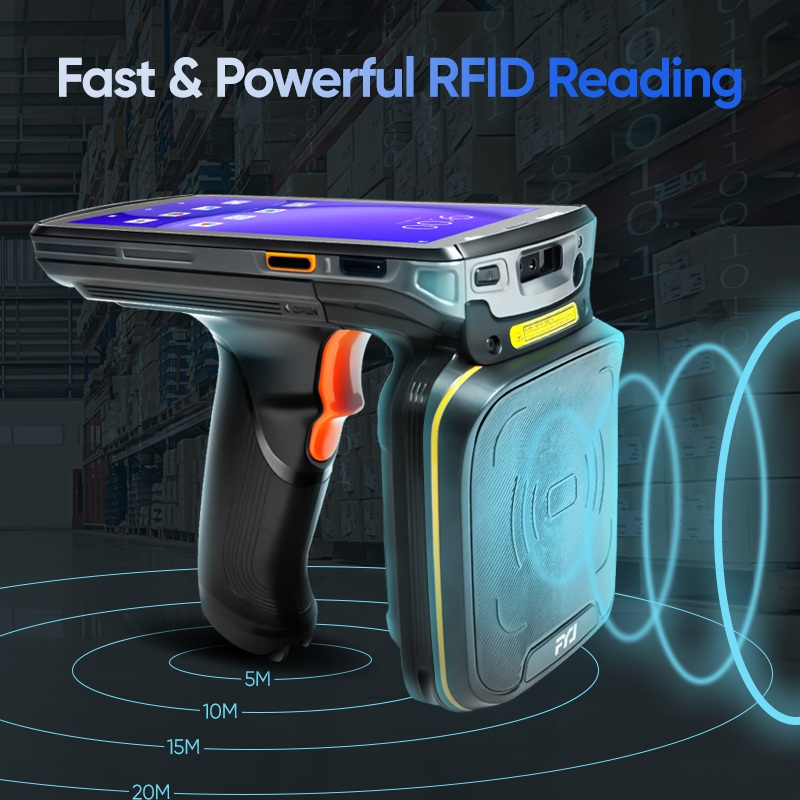
An RFID handheld reader is a mobile device that allows employees to carry RFID reading capability with them.
The main logic is simple:
The employee moves to the goods.
This makes handheld RFID especially suitable for:
Instead of scanning one barcode at a time, a UHF RFID handheld can identify multiple compatible RFID tags within its reading area.
Best Fit
Flexible, mobile RFID operations
A fixed RFID reader stays at a defined location and reads RFID tags within a controlled read zone.
The main logic is:
The goods move to or past the reader.
Typical applications include:
A fixed reader is usually selected when the same business event happens repeatedly at the same point.
Best Fit
Automatic RFID identification at a fixed process point
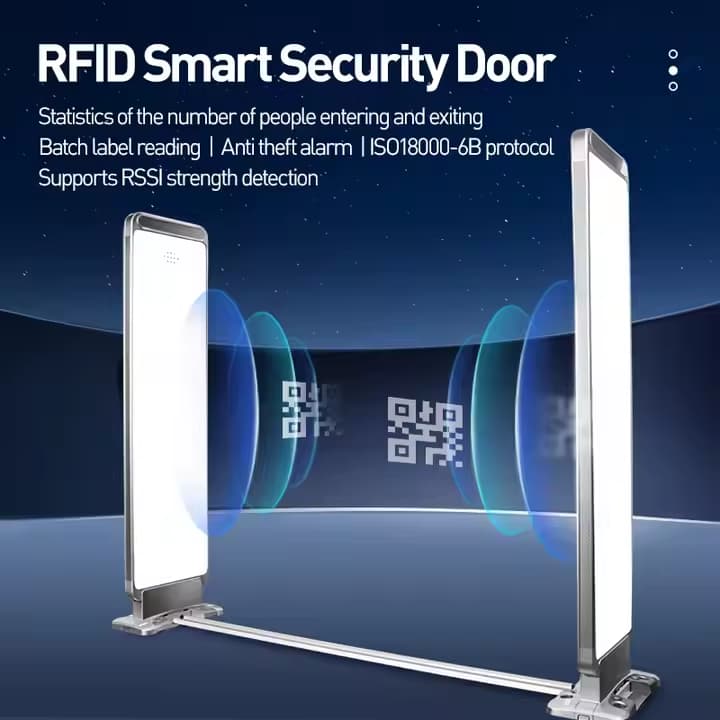
An RFID gate is a complete entrance or exit monitoring setup built around a controlled passage.
Its purpose is not simply to read tags.
Its purpose is to understand:
What moved through this entrance or exit, when did it move, and was that movement expected?
Typical applications include:
A gate system may include:
Choose an RFID Gate If:
Best Fit
Controlled entrance and exit monitoring
| Requirement | RFID Handheld | Fixed RFID Reader | RFID Gate |
| Mobile stocktaking | ✅ Best fit | ❌ | ❌ |
| Find a specific item | ✅ Best fit | Limited | ❌ |
| Flexible reading location | ✅ | ❌ | ❌ |
| Automatic identification | Limited | ✅ | ✅ |
| Conveyor identification | ❌ | ✅ Best fit | ❌ |
| Receiving / shipping station | ✅ | ✅ Best fit | Possible |
| Warehouse entrance / exit | Manual | Possible | ✅ Best fit |
| Unauthorized outbound alert | Limited | Possible | ✅ |
| Operator required | Usually yes | Usually no | Usually no |
| Reading position | Flexible | Fixed | Fixed entrance / exit |
| Multiple tag reading | ✅ | ✅ | ✅ |
The table is a starting point.
The final configuration still depends on the actual product, tag, software and workflow.
After the Canton Fair, one furniture hardware company discussed a project involving products such as door handles and related hardware.
The company wanted to manage its own dedicated storage area inside a distributor's warehouse.
Its main concern was not periodic stocktaking.
It wanted to know:
In this situation, asking employees to carry a handheld and manually scan every movement would still depend heavily on operator discipline.
A gate-based workflow is more aligned with the business requirement.
The goods pass through a defined entrance or exit, the RFID system captures the tags, and the software records the movement event.
The key point is:
The reader type should follow the business event.
If the main problem is stocktaking, evaluate a handheld.
If the main problem is automatic movement through a fixed checkpoint, evaluate a fixed reader or gate.
This is an important distinction.
A fixed RFID reader is a hardware device.
An RFID gate is a complete application built around an entrance or exit.
In simple terms:
Fixed RFID Reader = Reading hardware
RFID Gate = Entrance / exit monitoring solution
A fixed reader may be installed in many places:
An RFID gate adds the physical passage and business logic required to interpret movement.
For example:
Raw RFID event:
Tag EPC 123 was detected.
Business event:
Product A left Warehouse 1 through Exit Gate B at 14:32.
That difference is critical.
Often, yes.
A warehouse may use different RFID devices at different stages.
For example:
RFID Printer
Prints and encodes RFID labels.
↓
RFID Handheld
Used for inventory, locating, receiving and picking.
↓
Fixed RFID Reader
Used at automated receiving or shipping points.
↓
RFID Gate
Used for final inbound or outbound monitoring.
This means the real question is not always:
“Which reader is best?”
A better question is:
“Which reader fits each step of the workflow?”
Example Warehouse RFID Workflow
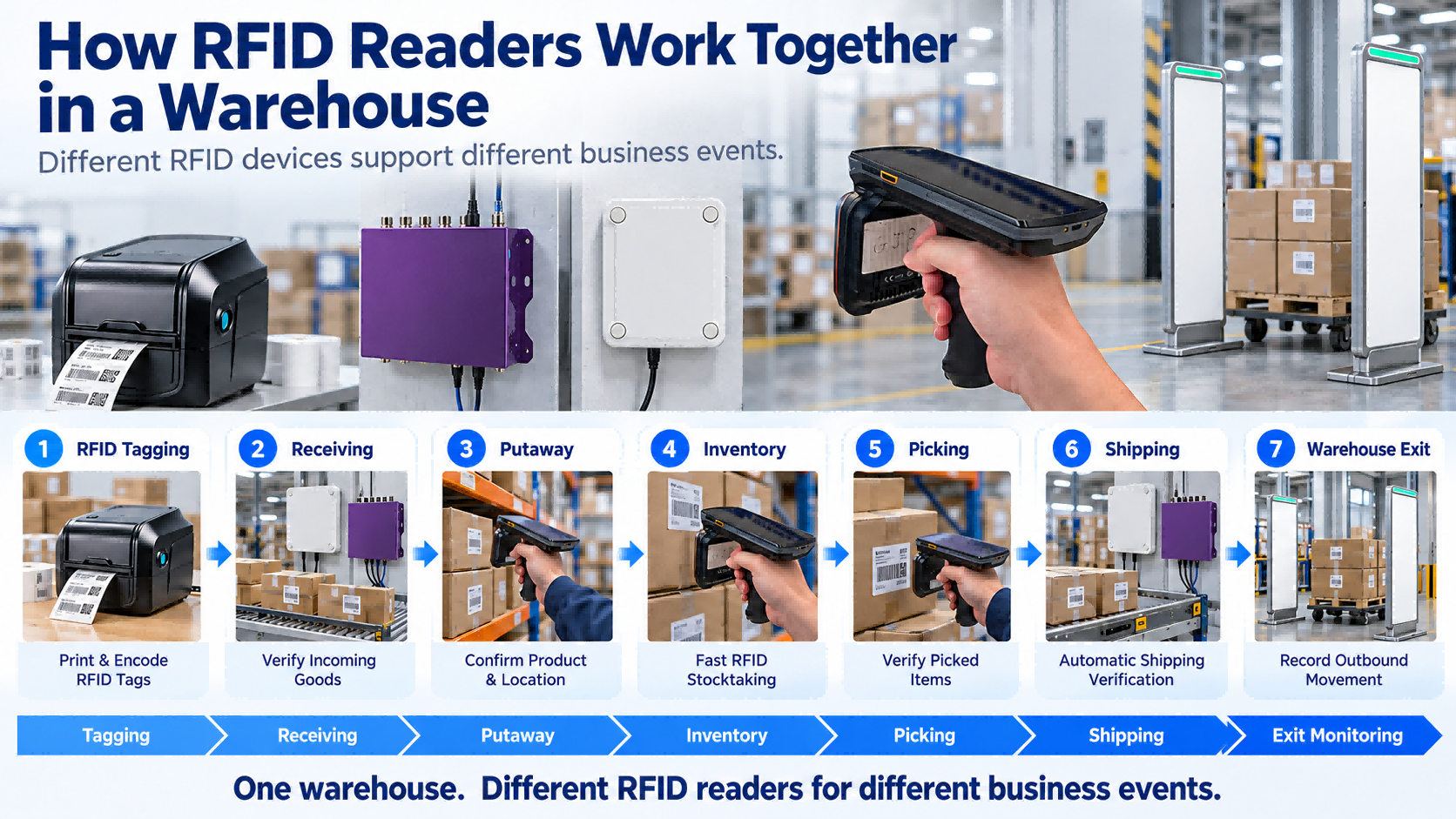
A complete warehouse may use RFID like this:
1. Tagging
RFID labels are printed and encoded.
2. Receiving
A handheld or fixed reader verifies incoming goods.
3. Putaway
The handheld confirms product and storage location.
4. Inventory
Employees walk through the warehouse with the RFID handheld.
5. Picking
The handheld verifies picked items.
6. Shipping
A fixed reader checks goods at the shipping station.
7. Exit
An RFID gate records final outbound movement.
The workflow becomes:
Tagging → Receiving → Putaway → Inventory → Picking → Shipping → Exit Monitoring
Different readers serve different business events.
Choose a handheld when the main requirement is:
A handheld is especially useful when the warehouse layout changes or the reader needs to follow the employee.
If people move to the goods, start with a handheld.
Choose a fixed reader when the main requirement is:
If goods move past the same point repeatedly, start with a fixed reader.
Choose an RFID gate when the main requirement is:
Simple Decision
If goods move through a controlled doorway, evaluate an RFID gate.
Usually, that is not the best design goal.
A warehouse does not need RFID readers everywhere.
It needs RFID at the points where identification creates business value.
For example:
This is often more practical than trying to make one device handle every task.
Before selecting a reader, answer these questions.
1. What Are You Tracking?
Products, cartons, pallets, tools or fixed assets?
2. What Is the Main Task?
Inventory, locating, receiving, shipping or entrance/exit monitoring?
3. Do Employees Move to the Goods?
If yes, start by evaluating an RFID handheld.
4. Do Goods Move Through a Fixed Point?
If yes, evaluate a fixed RFID reader.
5. Do Goods Pass Through a Controlled Entrance or Exit?
If yes, evaluate an RFID gate.
6. How Many Tags May Be Read at Once?
This can affect tag, antenna and reader configuration.
7. What Reading Distance Is Required?
Test the actual product and tag instead of relying only on the maximum advertised distance.
8. Does Your Existing Software Support RFID?
If you already use a WMS, ERP, POS or self-developed system, confirm whether RFID functions already exist.
If not, your software provider or technical team may need to develop them.
Mistake 1: Buying a Handheld for a Fully Automatic Process
A handheld still requires an operator.
If the goal is automatic inbound or outbound monitoring, evaluate a fixed or gate-based setup.
Mistake 2: Installing Fixed Readers for a Mobile Inventory Problem
If employees need to move around the warehouse to count or locate stock, handheld RFID may be more practical.
Mistake 3: Buying an RFID Gate Without Defining Business Logic
The gate can detect tags, but the software must still determine:
Mistake 4: Choosing the Reader Before Testing the Tag
The reader and RFID tag work as one system.
The product material, tag placement and environment all affect performance.
Mistake 5: Trying to Use One Device for Every Workflow
Different process points may require different reader types.
The goal is not to use the fewest device types.
The goal is to build the simplest system that reliably supports the workflow.
Testing should use real operating conditions.
Evaluate:
For handheld applications, test:
For fixed-reader applications, test:
For RFID gate applications, also test:
A successful RFID test is not simply:
“Can the tag be read?”
It is:
“Can the correct tags be read reliably at the correct point in the workflow?”
What is the difference between an RFID handheld and a fixed RFID reader?
An RFID handheld is mobile and normally operated by a person. A fixed RFID reader stays at a defined location and is commonly used for automatic identification.
Which RFID reader is best for warehouse inventory?
For flexible warehouse stocktaking, an RFID handheld is usually the first reader type to evaluate.
Can an RFID handheld read multiple tags?
Yes. UHF RFID handheld readers can identify multiple compatible RFID tags within the reading area.
What is a fixed RFID reader used for?
Fixed readers are commonly used at conveyors, receiving stations, shipping points, production lines and other defined read zones.
What is an RFID gate used for?
An RFID gate is used to monitor tagged goods moving through a controlled entrance or exit.
Is an RFID gate the same as a fixed RFID reader?
No.A fixed reader is the RFID reading hardware. An RFID gate is a complete entrance/exit application that may use a fixed reader together with antennas, gate structure and software logic.
Can an RFID gate automatically record inbound and outbound goods?
Yes, when the RFID hardware is combined with software rules that interpret the detected tags as inbound or outbound events.
Can an RFID gate detect unauthorized outbound movement?
Yes, if the system compares detected tags with authorized outbound records and triggers alerts for unexpected movement.
Do I need an RFID gate for warehouse inventory?
Usually not.For mobile stocktaking, an RFID handheld is typically more suitable.
Can handheld and fixed RFID readers work together?
Yes.Many RFID projects use handheld readers for mobile tasks and fixed readers for automated checkpoints.
Can RFID readers connect to an existing WMS or ERP?
Yes, but the existing system must support RFID or the required RFID functions must be developed.
Should I choose the RFID tag or reader first?
They should be evaluated together.
The product, tag, reader and workflow all affect RFID performance.
Choosing between an RFID handheld, fixed reader and RFID gate is mainly about where the RFID event happens.
Use an RFID handheld when:
People move to the goods.
Use a fixed RFID reader when:
Goods move past a fixed read point.
Use an RFID gate when:
Goods move through a controlled entrance or exit.
And in many warehouse projects, you do not need to choose only one.
Different RFID readers can work together at different stages of the workflow.
The right RFID reader is not the one with the longest reading range. It is the one that fits the business process.
Hi! Click one of our members below to chat on
 en


 IPv6 network supported