

In simple terms, RFID is a technology that gives physical objects their own "electronic ID." Using a reader, information can be read from a distance and without any physical contact, enabling highly efficient management.
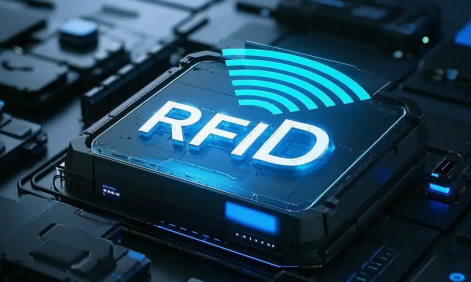
The composition of RFID is quite straightforward, primarily consisting of three key components:
01 Electronic Tag
A miniature device that stores the target's information. It acts as a wireless ID card, receiving energy, parsing commands, and responding with data.
02 Antenna
The physical pathway for transferring energy and signals between the reader and the tag. It is responsible for transmitting and receiving these signals.
03 Reader/Writer
A digital transceiver, such as an Industrial UHF RFID Reader Writer, that initiates communication, processes signals, and manages data exchange. It functions essentially as a "wireless card reader."
Common RFID devices we encounter include RFID handheld terminals, RFID printers, RFID gate antennas, and RFID fixed readers. These devices are not only capable of reading traditional barcodes but are also widely applied in scenarios such as logistics and warehousing, retail management, and asset tracking.
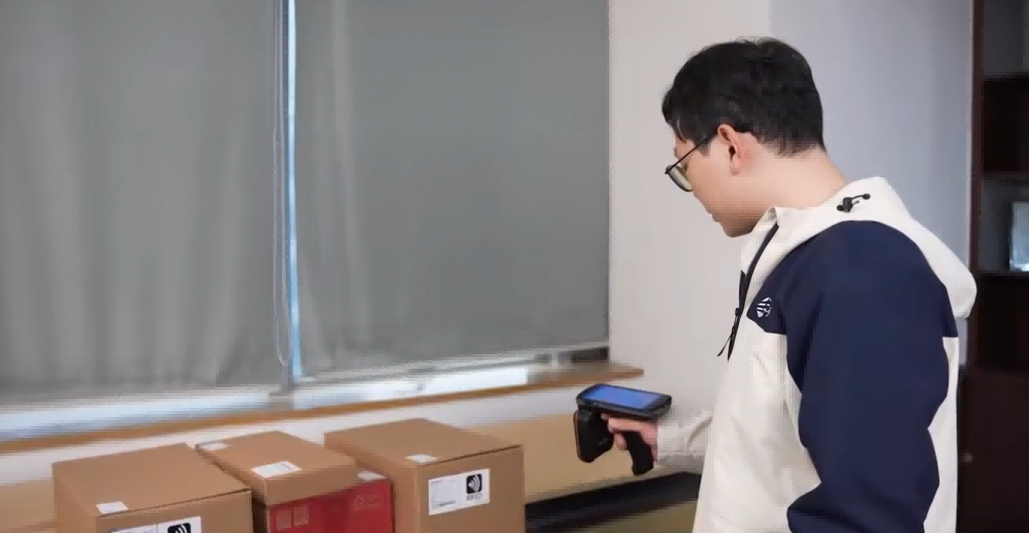
Compared to traditional identification methods like optical or barcode scanning, the simplest way to put it is: a barcode needs to be seen to be scanned, while RFID needs only to be sensed to be read.
The most fundamental differences are:
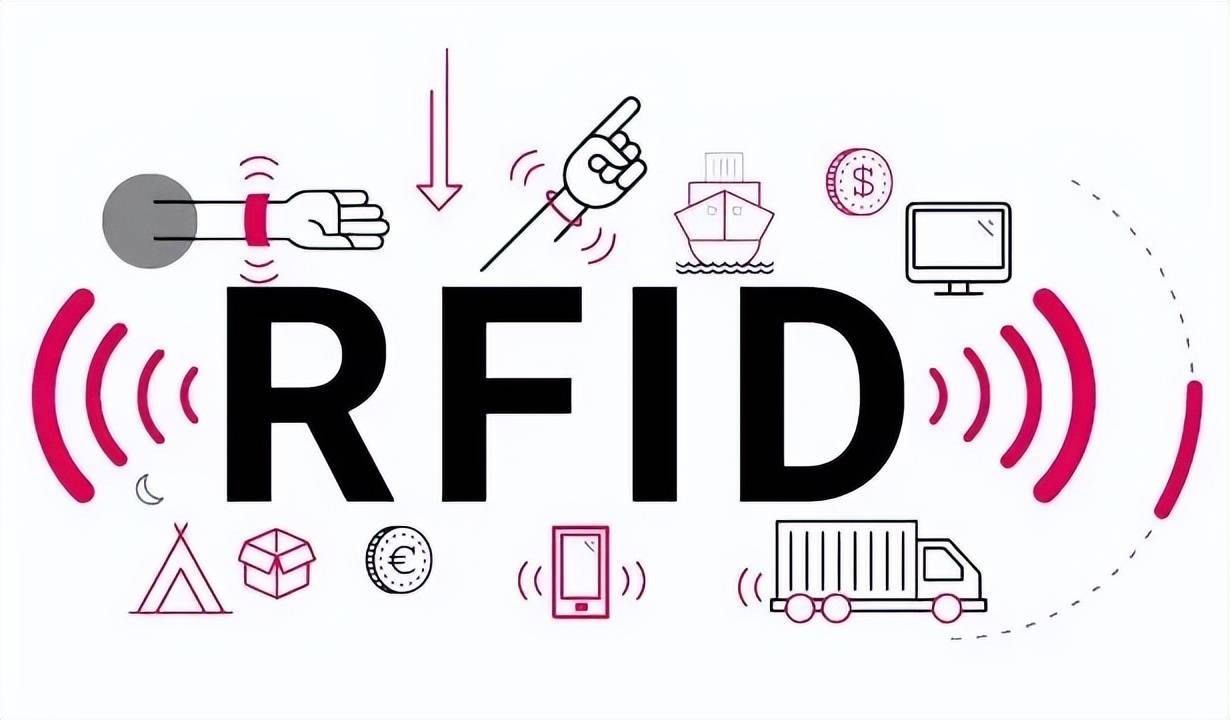
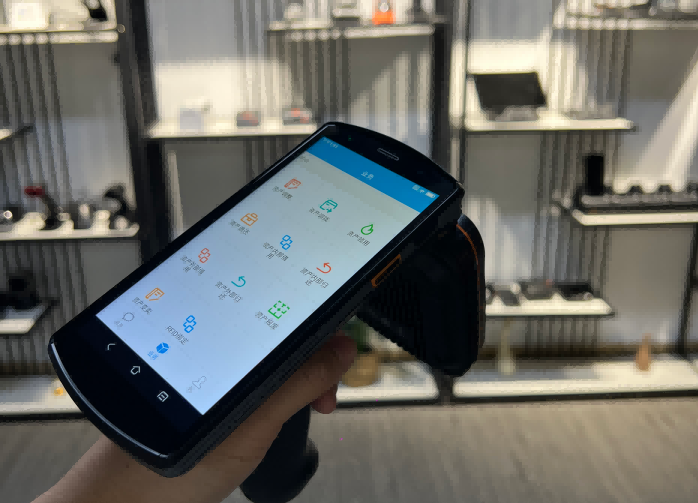
RFID Inventory: By implementing a Warehouse RFID Inventory Management System, four personnel equipped with readers can complete the inventory by walking through the aisles once, finishing in half a day with an accuracy rate exceeding 99%. During inbound and outbound operations, RFID channels automatically register items, improving efficiency by 80%.
Barcode Inventory: Twenty-four personnel need to push ladders and use handheld scanners to scan items one by one. Accessing top shelves requires climbing ladders, while bottom shelves necessitate moving items aside. When barcodes are dirty or damaged, manual checks against records are required, resulting in longer processing times and an accuracy rate of approximately 90%.
Key Takeaways:
RFID enables "walk-and-scan" batch inventory and "touchless" automated inbound/outbound logging—essentially automated data capture. It frees staff from repetitive, manual aiming and positioning tasks, dramatically boosting speed and accuracy. Barcode relies on "one-by-one" manual scanning—an inherently manual process. Efficiency is limited by personnel movement, item positioning, barcode quality, and the physical constraint of single-item scanning, making it time-consuming and error-prone.
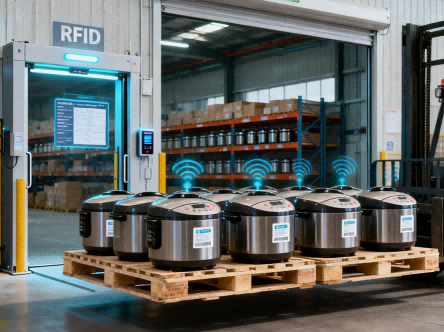
RFID Management: A quick scan with an RFID reader immediately identifies material models and quantities. Production lines do not require dedicated scanning points; semi-finished products automatically update their progress as they pass through each process step, reducing the rework rate from 8% to below 1%.
Barcode Management: When workers retrieve materials, barcodes often fail to scan due to misalignment or dirt, requiring manual reference to ledgers and increasing the risk of retrieving incorrect materials, which leads to defective products and rework. Production lines also require workers to stop and scan barcodes, which can easily cause bottlenecks in the workflow.
RFID transforms manufacturing into a continuous, data-driven flow, eliminating manual scanning bottlenecks and ensuring real-time traceability with minimal errors. Barcode systems, by contrast, remain prone to human error, scanning failures, and process interruptions, ultimately reducing overall production efficiency and quality.

RFID Management: Integrated with powerful Enterprise Fixed Asset Tracking Software, a single scan with a handheld RFID reader can batch-read asset information, reducing the annual inventory cycle from 5 workdays to just half a day and increasing the asset record-to-reality match rate from 75% to over 99%.
Barcode Management: When QR code labels are worn, detached, or dirty, they become unscannable, often requiring manual checks against paper records or spreadsheets. This frequently leads to misidentified equipment or mismatches between records and actual assets, resulting in low inventory efficiency.
RFID enables rapid, accurate, and automated asset tracking, transforming inventory from a lengthy manual audit into a swift digital process. Barcode systems remain vulnerable to label degradation and manual lookup errors, resulting in slower operations and inconsistent record-keeping.
As a comprehensive RFID solution provider, our company possesses multiple proprietary core technologies and a rich software ecosystem. We offer a variety of RFID tools tailored to the needs of different industries and can provide customized, integrated hardware-software RFID solutions based on specific industry requirements. Contact us for a free trial!

Hi! Click one of our members below to chat on
 en
en 


 IPv6 network supported